
Cold-Weather Booth Setup: Wind, Light, and Days That End at Four
A booth built for August falls apart in November. What to change for wind, cold and a market that ends after dark — before the first cold Saturday teaches you.
 1 min read
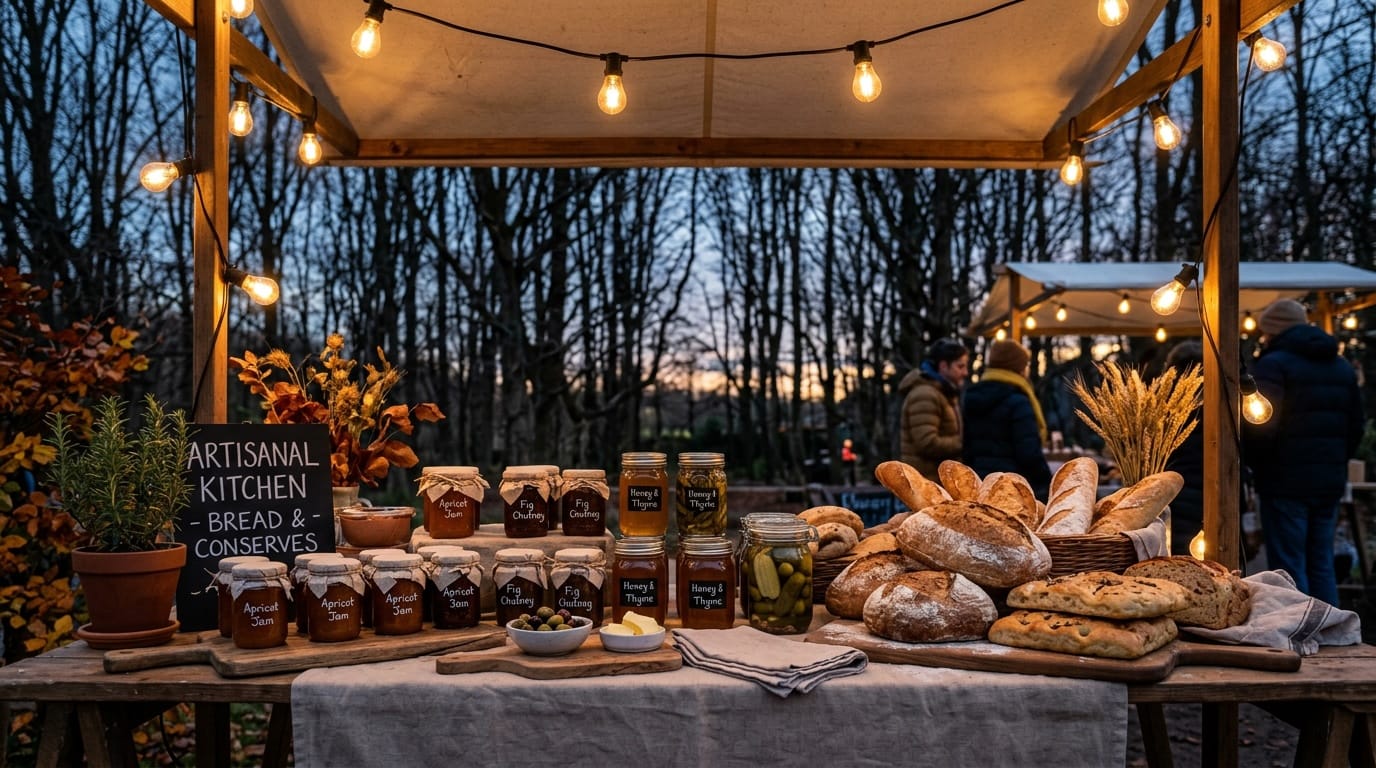
The first genuinely cold market of the year is educational. You find out that your tablecloth is a sail, that your hands do not work, that your card reader has opinions about temperature, and that it is fully dark twenty minutes before you are allowed to pack up.
None of this is hard to solve. It is just that a booth built in June is optimized for a completely different set of problems, and nobody rebuilds it until the day it fails.
Wind is the one that will actually cost you money
A summer breeze moves your napkins. A November gust takes the whole canopy into someone's car, and every market has that story. Most markets require weights by this point in the season, and the ones that do not still should.
The number worth knowing: plan on about 24 pounds per leg, more if you are on an exposed corner or in a parking lot with nothing to break the wind. Not a gallon jug of water, which is roughly eight pounds and mostly decorative. Proper weights, sandbags, or PVC pipe filled with concrete if you want the cheap version.
Then, the parts people forget:
Take one wall off, or put one on. A canopy with no sides is a kite; a canopy with three sides is a parachute. Three sides with the back to the wind is usually right, and it doubles as a windbreak for you.
Clip the tablecloth down. Binder clips, four of them, thirty cents. A cloth that lifts takes light products with it.
Move the light stuff to the middle and the heavy stuff to the edges, which is the opposite of how you merchandise in summer. Your prettiest tall display is now a liability at the front corner of the table.
Dark at four changes what people can see
This is the one vendors underestimate. From about the middle of October a late-afternoon market finishes in real darkness, and market lighting is usually a streetlamp doing its best.



People do not buy food they cannot see properly. Baked goods look grey. Jars look brown. Labels become unreadable, which matters more than it sounds, because a customer who cannot read your label does not ask — they move on.
A battery-powered LED strip or two clip lights aimed at the table, not at the customer, fixes almost all of it. Warm white, not the blue-white ones, which make everything on your table look like it is in a hospital. Bring more battery than you think; cold drains them faster.
And make one sign bigger than feels necessary. In low light, the sign that was perfectly legible in July is now a grey rectangle.
Cold hands, cold product, cold customers
Three separate problems that share a cause.
Your hands. Fingerless gloves, and practice making change with them on before market day. Handling money and bags with numb fingers is slow, and slow at a cold market is how a line evaporates.
Your products. Chocolate sets hard and dull. Frosting goes stiff. Bread firms up and reads as stale even when it is perfect. Caramel and anything soft-set gets unhappy near freezing. If you sell something temperature-sensitive, keep the backstock in a cooler — a cooler holds warmth in as well as it holds cold in — and put out small quantities at a time.
Your customers. Cold shoppers do not browse. They walk with purpose, they buy the thing they came for, and they leave. That means the slow-build display that worked in summer stops working. Put your best-selling item at the front, priced clearly, in a grab-and-go format. The person who would have lingered for six minutes in July has ninety seconds now.
The small things that make the day survivable
Cardboard or a scrap of rug under where you stand. Standing on cold asphalt for four hours pulls heat out of you faster than the air does, and it is the single cheapest comfort upgrade there is.
A thermos of something hot, and a second one to share. Vendor goodwill in November is worth real money in referrals.
Keep your phone and card reader against your body between customers. A cold battery reports itself as dead at thirty percent, and a reader that will not connect while somebody stands there with their wallet out is a sale you already made and then lost.
Pack a headlamp for teardown. Loading out in the dark with your phone flashlight in your teeth is a rite of passage you only need once.
None of this is glamorous, and none of it goes on your table. It is the difference between a late-season market you can keep doing through December and the one that makes you decide outdoor season ends in October.

If you have been through a few cold seasons, you have a trick I have left out — the market veterans always do. Come tell the Collective what it is, preferably before the first freeze catches somebody out.

Keep reading
More from the market
Selling from a Farm Stand: What It Takes and What It Makes
A stand at the end of the drive has no booth fee and no set hours. What to check before you build…
Read more
Buying Ingredients in Bulk Without Wasting Money
The bulk bag is only a saving if you use it in time. How to work out your true break-even, which ingredients…
Read more
How to Freeze Your Farmers Market Haul (Without a Freezer Full of Regret)
No canner, no jars, no boiling water bath. What to blanch first, what to freeze raw, what to skip entirely, and how…
Read more