
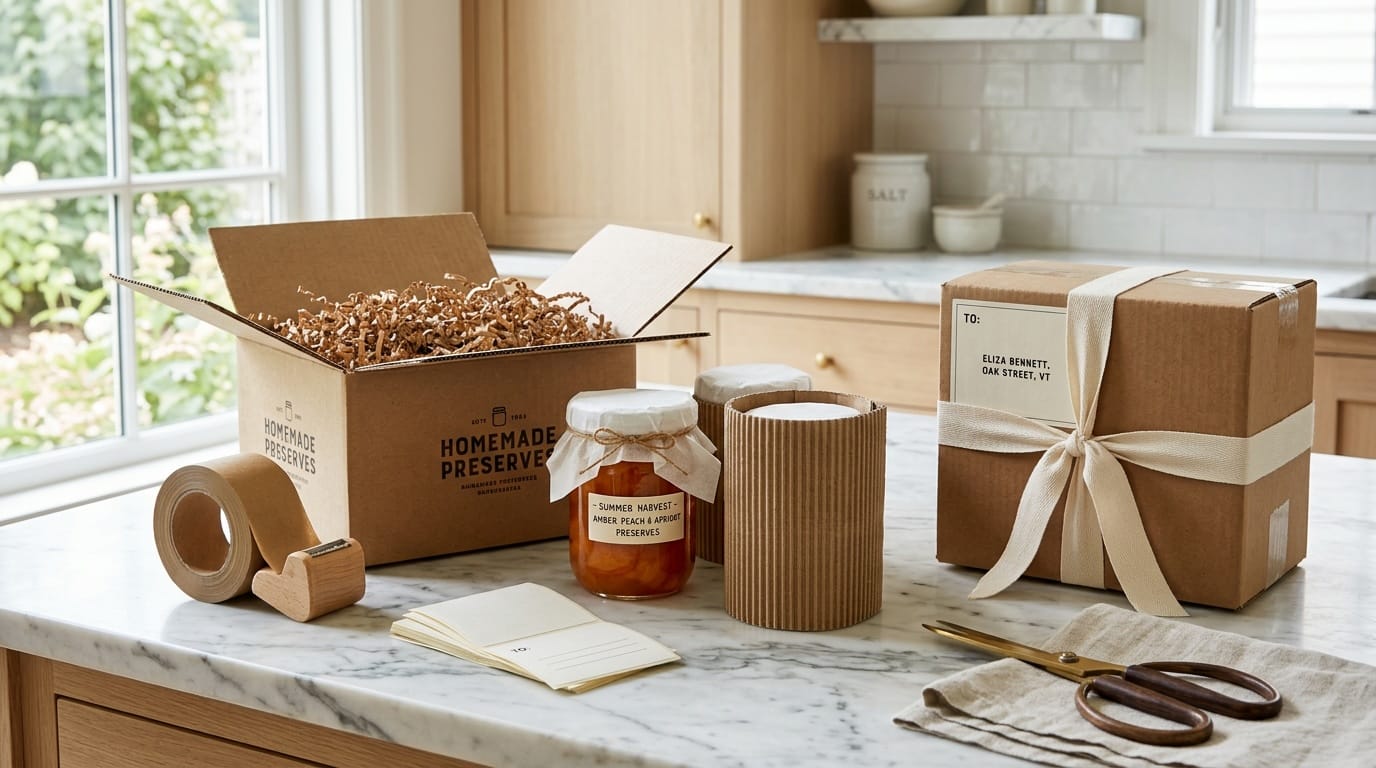
The first time you ship an order, it feels like a promotion. Someone three states away found your shop and wants your caramel sauce. You wrap it in whatever's in the closet, stand in line at the post office, pay eighteen dollars you weren't expecting, and then spend four days quietly terrified.
Then it arrives cracked, and you refund the whole thing, and now you're down the product, the shipping, and the customer.
Shipping is where a lot of otherwise healthy cottage food businesses quietly bleed out, usually right around the holidays when volume spikes. It doesn't have to. Learning how to ship cottage food products well comes down to three decisions — a box decision, a cushioning decision, and a pricing decision — and you make each of them once.
Before you learn how to ship cottage food products, decide what you'll ship
Before anything else, be honest about what survives four days in an unheated truck in August or a freezing one in January. This is a product decision, not a packing decision, and getting it wrong is the most expensive mistake on this list.
Ships beautifully: jams, jellies, honey, hot honey, hard candy, brittle, granola, dry mixes, spice blends, drinking vinegars and shrubs, cookies (sturdy ones), biscotti, crackers, caramels in cool weather, coffee, tea.
Ships with effort: soft cookies, quick breads, brownies, cinnamon rolls, chocolate-anything (October through April only, and even then watch the forecast), decorated cookies (they need a rigid inner box and they still break).
Do not ship: anything needing refrigeration, tall layer cakes, meringue, anything with a fresh cream or custard filling, macarons if you value your sanity. Also — and this is the big one — check whether your state's cottage food law permits mail-order or out-of-state shipping at all. A lot of states allow direct in-person sales only, and some allow in-state shipping but not across state lines. Sort that out before you build a website around it.
If you want the customer three states away and shipping doesn't work for your product, the answer isn't a better box. It's a shelf-stable version of your product built specifically to travel — a spice rub, a dry mix, a jar. Plenty of vendors have turned a fragile bestseller into a shippable second product line and doubled their reach.
The box rules that actually prevent breakage
Almost every broken-jar story comes down to one of three things: the product touched the box wall, the product touched another product, or the box had room to rattle.
- Two inches of cushioning on every side. Every side. Including the bottom, which is the side that gets dropped on.
- Nothing touches anything. Jars get individually wrapped — bubble wrap, corrugated jar sleeves, or a good thick wrap of packing paper — and then they get separated from each other with dividers or more cushioning. Glass hitting glass is the number one killer.
- No empty space. Close the box and shake it. If you hear or feel movement, add more fill. A tight box is a strong box; the packing material is structurally holding the walls apart.
- Double-box anything you truly can't afford to replace. A small box inside a bigger box with two inches of fill between them survives things a single box does not.
- Seal every seam with real packing tape, three strips, top and bottom. Not the tape from the junk drawer.
- Bag anything that could leak. A honey jar in a sealed poly bag means a cracked jar is a sad email, not a ruined box of everything else.
For baked goods, the enemy is different — it's air and movement, not impact. Cool completely (a warm cookie in a sealed bag steams itself into a sponge), seal in food-safe bags with as little air as you can manage, then pack the bags snugly so they can't slide. A rigid inner box for anything with an edge that can chip.
Cold weather, hot weather, and the calendar
Heat is the variable that ruins the most orders and the one most vendors ignore until July.
Anything with chocolate, a soft caramel, or a coating turns into a science experiment above about 80°F, and the back of a delivery truck runs far hotter than the air outside. Your options are: don't ship those products between May and September, ship them with a cold pack and expedited service and charge accordingly, or post a clear seasonal note and let customers buy at their own risk. All three are legitimate. Pretending it isn't happening is not.
The reverse matters too: some products don't love freezing. If you ship jars in January, know that a partially frozen jam can crack the glass.
Practical rule: ship early in the week. A package that leaves on Thursday spends the weekend somewhere unheated or unrefrigerated. Monday and Tuesday are your friends.
What it actually costs, and how to price it
Here's the part people skip. Shipping cost is not postage. Shipping cost is:
Postage + box + cushioning + inner packaging + tape + label + the time it takes you to pack it.
That last one is real money. If it takes you twelve minutes to pack an order and you value your time at even $20 an hour, that's $4 before you've bought a single box. Vendors who "just charge actual postage" are running the shipping side of their business at a loss and calling it customer service.
Weigh and measure a fully packed representative order. Actually do it — put a real order on a real scale in a real box. Then price using one of three models:
- Flat-rate shipping — one price for every order. Simple for the customer, and it averages out if your orders are similar in size. Set it from your expensive zone, not your cheap one, or you subsidize every distant customer.
- Free shipping over a threshold — the most effective at raising order value, as long as the shipping cost is genuinely built into your product prices and the threshold is high enough to cover it. "Free shipping over $50" when shipping costs you $12 means your $50 order needs to carry $12 of margin it didn't before.
- Calculated at checkout — most accurate, most honest, and the highest cart-abandonment rate of the three. Good for heavy items where a flat rate would be brutal.
Whichever you pick, build the packaging materials into your product price rather than the shipping line. Customers scrutinize the shipping number and barely notice a dollar on the product.
The unglamorous operational stuff
- Buy postage online. Commercial rates through any shipping platform beat retail counter prices meaningfully, and you skip the line.
- Always send tracking. Automatically, the moment the label prints. Roughly half of "where is my order" emails disappear.
- Set expectations in writing. "Orders ship within 3 business days. Delivery is typically 2–5 days after that." Put it on the product page, in the confirmation email, and on your shop. Most complaints are expectation problems, not shipping problems.
- Photograph the packed box before it goes out, at least while you're learning. It settles disputes and it shows you what failed.
- Include a card. A handwritten thank-you and a storage note costs almost nothing and is the entire reason someone orders from a person instead of a warehouse.
- Buy boxes in bulk before November. Holiday supply gets tight and expensive, and nothing wrecks a good December like paying retail for corrugated.
When something breaks anyway
It will, occasionally, no matter how well you pack. Have the policy decided before it happens: replace or refund, no argument, ask for a photo, and thank them for telling you. Then look at the photo and figure out which of the three failure modes it was. Every broken order is free research if you actually read it.
Build a breakage allowance into your pricing — one or two percent of shipped revenue — so that when it happens it's a line item instead of a gut punch.
Get the box right once, price it honestly once, and shipping stops being the scary part of your business and starts being the part that lets someone in another state become a regular.
Butter & Sage Market
Sell locally and ship nationally, from one shop.
Butter & Sage Market gives you a real storefront with local pickup, market day drops, and shipping — so the customer down the street and the one three states away both get what they need.
Fresh. Local. Sustainable.



0 Comments