

You sold out by eleven. You drove home with an empty van and a cash box that felt satisfyingly heavy, and you told your partner it was a great day.
Was it, though?
Not a trick question — a real one, and most vendors genuinely cannot answer it. They know what came in. They have a fuzzy sense of what went out. Somewhere between those two numbers is the answer to whether this business is a business or an expensive way to bake for strangers, and it's worth actually finding out.
Good news: cottage food business bookkeeping is not accounting. You do not need software with a monthly fee or a class in double-entry anything. You need three habits and about twenty minutes a week.
Cottage food business bookkeeping, habit one: separate the money
This is the single most useful thing on the list and it costs nothing.
Open a second checking account — a free one at your existing bank is fine — and run every dollar of the business through it. Ingredients, jars, market fees, booth canopy, the label printer, all of it comes out of that account. Every sale goes into it. Get a debit card for it and use that card for nothing else.
Do this and your bank statement becomes your bookkeeping, more or less for free. Skip it and you will spend hours every spring trying to remember whether that $94 grocery run was flour for the business or groceries for the house. (You won't remember. Nobody remembers.)
If you use a personal card for a business purchase because you forgot the other one, transfer yourself the money the same day so it lands in the right account. It takes ten seconds and keeps the trail clean.
Habit two: know your cost per unit
This is where most of the surprises live. You probably know what a batch costs. You may not know what a jar costs, which is the number that matters.
For one product, add up:
- Ingredients — the actual cost of what goes in, calculated down to the unit. Not "a bag of sugar," but the fraction of the bag this batch used.
- Packaging — jar, lid, band, label, ribbon, bag, sticker, box. All of it. This is almost always higher than people guess, and it's the line that quietly grows every time you make the packaging a little nicer.
- Direct costs — the gas for the ingredient run, the propane, the parchment.
- Your labor — hours spent making, packaging, and labeling, at a real hourly rate. Pick a number you would accept from someone else. If you leave this out, you are not calculating profit, you are calculating how much you're donating.
Divide by the number of units the batch yields. That's your cost per unit. Your price should be a healthy multiple of it — not a dollar more than it. If you want the full pricing math, we walked through it in the simple pricing formula every farmers market vendor needs to know.
Redo this twice a year. Ingredient costs move, and the jar you paid $0.94 for in 2024 is not $0.94 anymore.
Habit three: track the overhead you forget
Cost per unit tells you the margin on a jar. It does not tell you whether the business makes money, because it leaves out everything you pay for whether you bake or not.
Keep a running list, monthly or annually:
- Market stall fees and season application fees
- Insurance
- Permits, registrations, license renewals
- Website, domain, shop fees, payment processing (that 2.9% + 30¢ adds up faster than you think)
- Canopy, tables, tablecloths, display, signage, the wagon
- Equipment — the mixer, the sheet pans, the label printer, and the repairs
- Mileage to and from markets (track it, it's a real deduction)
- Marketing, business cards, samples given away
Divide the annual total by the number of market days or sales days you expect, and you get your daily nut — what you must clear before a single dollar counts as profit. Vendors who know this number make better decisions about which markets to keep, because "that market covers its own booth fee and $30 more" is a very different sentence from "that market feels slow."
The twenty-minute weekly ritual
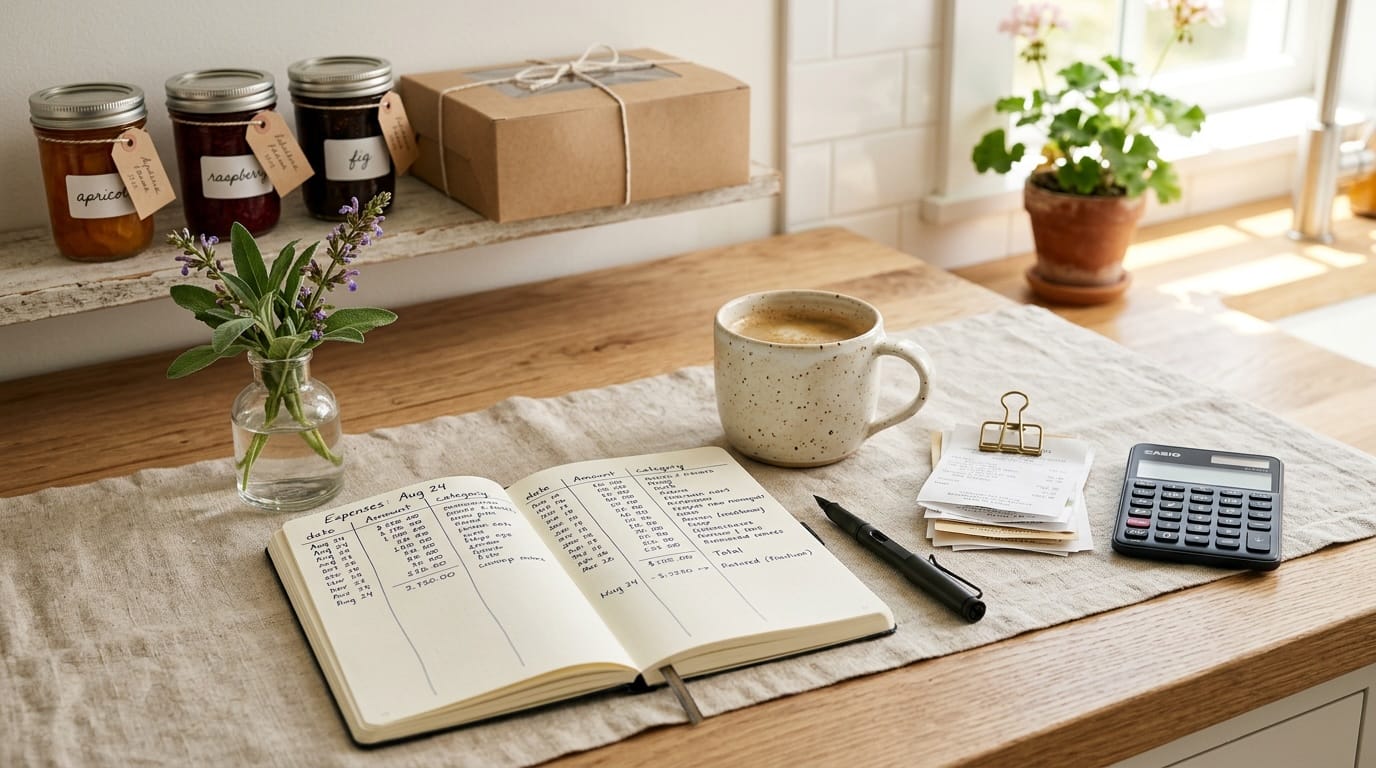
Same day every week. Sunday evening, coffee, twenty minutes.
- Record the week's sales — total, and split by channel if you sell in more than one place. Market, online, custom orders, wholesale. You want to know which channel is actually carrying you.
- Enter the receipts. Photograph them as you get them and clear the pile weekly. A shoebox in April is a genuinely miserable day.
- Log your hours. Rough is fine. Baking, packing, market day, admin. You are looking for a trend, not a timesheet.
- Move money for taxes. Transfer a fixed percentage of the week's sales into a separate savings account and forget it exists. Self-employment tax is the thing that ambushes first-year vendors. Talk to a tax professional about the right percentage for your situation — but move something, every week, starting now.
A plain spreadsheet does all of this. Columns for date, description, category, amount in, amount out. If you later outgrow it, any bookkeeping software will import it happily. Start free.
The four numbers to look at monthly
At the end of each month, pull four figures. That's it.
- Revenue — everything that came in.
- Cost of goods — ingredients and packaging for what you actually sold.
- Gross margin — revenue minus cost of goods, as a percentage. This is the health of your pricing. If it's thin, no amount of volume fixes it. You cannot sell your way out of a bad margin.
- Net after overhead and your labor — what's genuinely left. This is the health of your business.
Then ask the three questions those numbers answer: Which product actually makes money? Which sales channel is worth the hours? Which market earns its booth fee?
The answers are frequently uncomfortable. The gorgeous, labor-intensive product everyone compliments is often the worst performer on the table, and the boring one you almost stopped making is carrying the whole booth. You cannot see that from a heavy cash box. You can only see it from a spreadsheet.
What to do with what you find
Cut or reprice the products that lose money. Drop the market that never clears its nut. Put your hours into the channel with the best margin per hour, not the one with the highest revenue — those are different, and the difference is your life.
Twenty minutes a week and you stop guessing. That's the entire pitch. A business you can see is a business you can steer, and most vendors are driving with the windshield fogged over for no reason other than nobody told them to wipe it.
Open the second bank account this week. Everything else follows from there.
Butter & Sage Market
Stop tracking sales in three different places.
Butter & Sage Market keeps your online orders, custom requests, market day pickups, and payouts in one shop, so the numbers you need at the end of the month are already in one place.
Fresh. Local. Sustainable.



0 Comments