
How to Save Seeds from Your Best Tomatoes and Peppers
The best tomato in your garden this year can be next year's whole crop, for free. Here's how to save tomato and pepper seeds, step by step, no equipment.
 1 min read
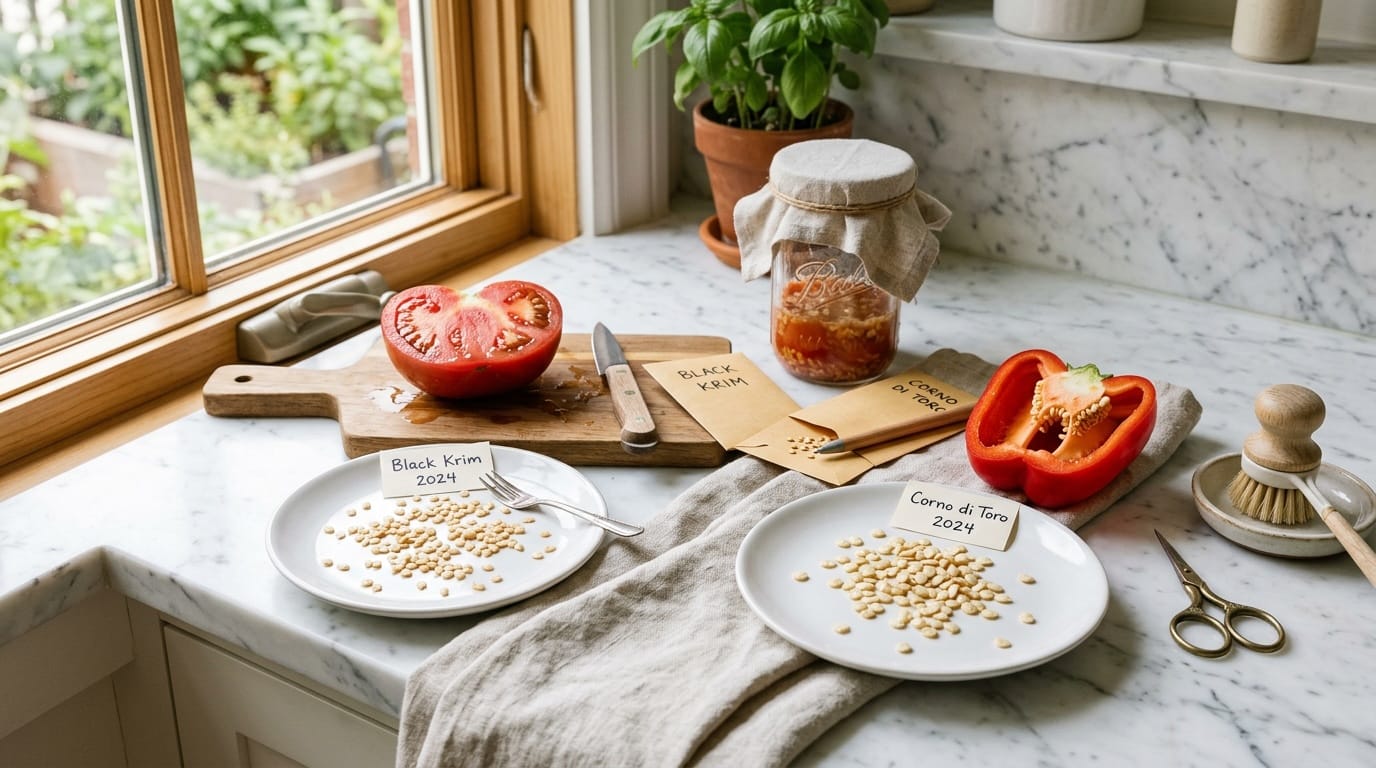
Somewhere in your garden right now there is one tomato that is better than all the others. It ripened first, or it's the sweetest thing you've eaten all summer, or the plant it came from shrugged off the heat wave in July that flattened everything around it.
That tomato is holding next year's entire crop inside it, for free, and most of us slice it up and never think about it again.
Late summer is seed-saving season, and learning how to save tomato seeds (and pepper seeds) is the easiest place in the whole garden to start. No equipment, no expertise, about ten minutes of actual work spread over a week. And if you're a market gardener, saving seed from your best-performing plants year after year is how you eventually end up with a variety that is genuinely, specifically adapted to your soil and your weather — something nobody can buy.
First: check whether your seeds are worth saving
One thing to get out of the way, because it saves disappointment next June.
If your plant is a hybrid, the seeds won't come true. Look at the tag or the seed packet — if it says F1, or "hybrid," the plant is the first-generation cross of two different parent lines. Its seeds will grow, enthusiastically, into something that is not the plant you liked. Sometimes that's a fun experiment. It is not a way to reproduce your favorite tomato.
If it's open-pollinated or heirloom, you're in business. Every heirloom is open-pollinated, and those seeds produce plants like the parent, year after year. If you don't know what you planted, heirloom names are a good clue — Brandywine, Cherokee Purple, San Marzano, Jimmy Nardello.
The good news for beginners: tomatoes are self-pollinating and rarely cross with a neighboring plant, so you can grow six varieties in one bed and still save clean seed from each. Peppers are a little friendlier to cross-pollination — bees do move between them — so if you're growing a sweet pepper next to a hot one, there's some chance next year's "sweet" pepper comes with a surprise. Twenty or thirty feet of separation, or just accepting the occasional oddity, handles it fine for a home garden.
Pick the right fruit
You are not just saving seed. You are choosing which plant gets to be next year's parent, which means this is the moment to be picky.
Take fruit from the plant that did what you want more of — earliest, most productive, best flavor, healthiest leaves, didn't crack, didn't get blossom end rot, kept going when it got hot. Take it from a plant that's clearly healthy, never one that struggled with disease.
And let the fruit get properly ripe on the plant. Riper than you'd pick it for eating — a tomato slightly past its prime has fully mature seed. For peppers, this means letting them turn their final color and go slightly soft, which for most varieties means red, not green. A green bell pepper's seeds are immature and won't germinate well.
Save from several fruits across a few different plants of the same variety if you can. It keeps a little genetic diversity in the mix.
How to save tomato seeds: the fermenting step
Tomato seeds are wrapped in a gel coating that contains germination inhibitors — the plant's way of stopping the seeds from sprouting inside a rotting fruit on the ground. You need to remove it, and the way you do that is to let it ferment, which is less dramatic than it sounds and mimics exactly what happens naturally.
- Cut the tomato across its equator and squeeze the seeds and gel into a small jar or cup. Add a splash of water — a couple of tablespoons.
- Cover loosely with a coffee filter, a scrap of cloth, or plastic wrap with a hole poked in it, and leave it on the counter out of direct sun.
- Wait two to four days. Stir once a day. A layer of white or grey mold will form on top. This is correct. This is the process working, and it smells about how you'd expect — put it somewhere you don't linger.
- Stop when the good seeds sink. When most of the seeds have settled to the bottom and the gel has broken down, you're done. Don't go much past four days or the seeds can start to sprout.
- Rinse. Pour off the mold, the pulp, and any floating seeds — floaters are usually not viable. Tip the rest into a fine mesh strainer and rinse under running water, rubbing gently with your fingers, until the seeds are clean and no longer slippery.
Peppers: much easier
No fermenting. No gel. Cut the fully ripe pepper open, scrape the seeds off the white pith with a spoon or your fingernail, and spread them out. That's the entire process.
Two notes. Wear gloves for hot peppers — capsaicin concentrates in the pith and it will find your eye hours later, and you will not enjoy it. And don't rinse pepper seeds if you can avoid it; they dry better and store better when they go straight to drying.
Drying, which is where people go wrong
This is the step that decides whether your seeds are alive next spring.
Spread the clean seeds in a single layer on a ceramic or glass plate, a coffee filter, or a piece of window screen. Not paper towel — the seeds bond to it permanently and you'll spend February picking at fuzz. Not in the oven, not in the sun, not on a heat mat. Warm room, good airflow, out of direct light.
Give it one to two weeks, and stir them around every couple of days so they don't clump. A properly dry tomato or pepper seed snaps when you bend it rather than folding. That's the test. If it bends, give it more time.
Label the plate the day you put the seeds on it. Every seed saver in history has stood over an unlabeled plate in September trying to remember. Variety name, and the year.
Storing them until spring
Cool, dark, dry. A paper envelope inside a sealed jar in the back of a closet or a cool basement is perfect. Add a silica gel packet if you have one lying around. The killer is moisture, and the second killer is temperature swings, so the kitchen windowsill is the worst possible place.
Stored properly, tomato seeds stay viable for four to six years and pepper seeds for two to three. Do a germination check in late winter if you want peace of mind: ten seeds on a damp paper towel in a sealed bag somewhere warm, and count how many sprout in a week. Seven or more and you're fine.
Why this is worth ten minutes
Partly it's the money — a packet of good heirloom seed runs four or five dollars, and one tomato gives you enough seed for years.
But the better reason is that seed saved from your own garden gets a little better every year. You're selecting, whether you mean to or not, for the plants that thrive in your conditions. Ten seasons of that and you have a tomato that's genuinely yours — one that handles your July, your soil, your particular corner of the world, better than anything in a catalog.
Growers have been doing exactly this for about ten thousand years. Every heirloom variety in every catalog exists because somebody liked a plant enough to keep its seeds.
Go find your best tomato. Don't eat that one.

Keep reading
More from the market
How to Put Your Garden to Bed for Winter (And Make Next Spring Easier)
What to pull, what to leave for the birds, and why covering bare soil now is the single best thing you can…
Read more
How to Grow Basil at Home (And Never Buy a Sad Plastic Clamshell Again)
How to grow basil at home — from starting plants to the pinching technique that keeps them producing all summer. A beginner-friendly…
Read more
What to Plant in August for a Fall Harvest
August isn't the end of the garden — it's the start of your fall harvest. Here's what to plant now for a…
Read more