How Much to Charge for a Loaf of Sourdough (And Why Batch Size Changes Everything)
How much to charge for a loaf of sourdough? We cost six-loaf and twelve-loaf bake days line by line, and show why batch size matters more than the flour.
 4 min read
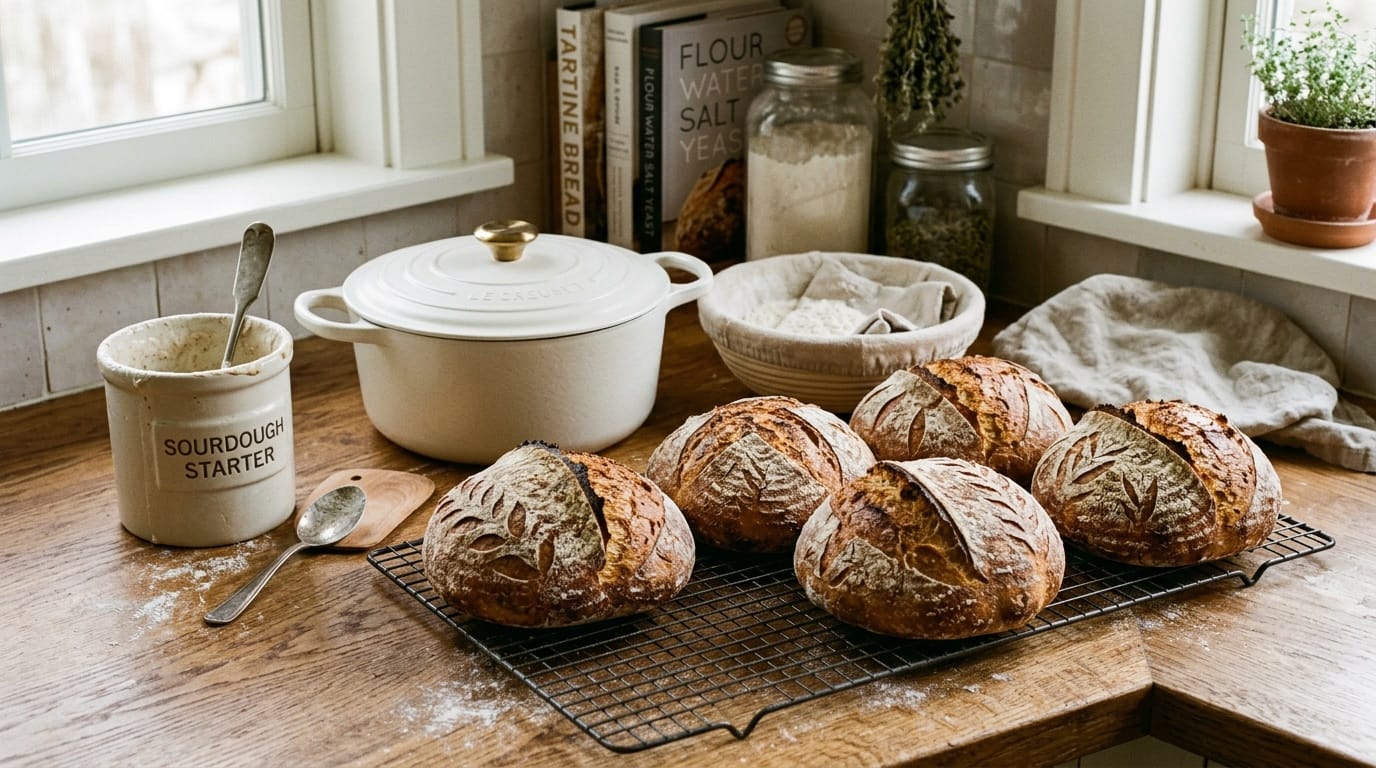
Here is the strange thing about sourdough. The flour in a loaf costs you less than a dollar, and the market down the road sells loaves for $9 to $12. So it looks like the most profitable thing you could possibly bake, right up until you count the hours. If you are trying to work out how much to charge for a loaf of sourdough, the answer depends less on flour than on one number most bakers never think about: how many loaves you bake at a time.
Let’s cost two real bake days, six loaves and twelve, with the same steps the free Recipe Pricing Calculator uses.
The formula: one plain country loaf
Each loaf uses 550 grams of bread flour in total (500 grams in the dough plus 50 grams to build the levain), 10 grams of salt and water. If you want to adjust hydration or batch size, the free Bread Calculator works out baker’s percentages and levain for you.
Store-brand bread flour was $3.98 for a 5-pound bag at a national grocer in October 2026, which is about 5 cents an ounce. Prices vary by region and climb quickly if you use organic or freshly milled flour, so use your own receipts.
- Flour, 550 grams (19.4 ounces): $0.97
- Salt, 10 grams: about $0.01
- Water: effectively free
Call it $0.98 a loaf. Six loaves is $5.87 of ingredients and twelve is $11.73 (we round every line to the cent, so the calculator may differ by a few pennies).
Overhead: the oven question
The calculator sets overhead as a percentage of your ingredient cost and suggests 15 to 20 percent for most home kitchens. For sourdough that goes badly wrong. Twenty percent of $5.87 is $1.17 to cover an entire bake day at high heat, Dutch ovens, parchment, rice flour and bannetons.
You can estimate the oven yourself. Virginia Cooperative Extension’s method is wattage times hours of use, divided by 1,000, to get kilowatt-hours (Virginia Tech). Suppose your oven’s rating plate says 3,000 watts and it runs three hours: that is at most 9 kWh. At the U.S. average of 19.6 cents per kWh for September 2026 (BLS), that is at most $1.76, and less in practice because the element cycles. Twelve loaves take about five hours of oven time, so at most $2.94.
Add equipment wear and supplies and 50 percent of ingredients is a fair overhead rate for bread: $2.94 for six loaves and $5.87 for twelve.
Packaging and labor
A loaf goes into a plastic bread bag with a tie ($0.15 each in a 100-pack) with a printed label ($0.22). That is $0.37 a loaf: $2.23 for six, $4.46 for twelve.
Labor is where sourdough fools people. The dough takes a day, but most of that is waiting. Count the time you are actually working or tending the oven:
- Six loaves: levain 10 minutes, mixing 20, four sets of folds 20, shaping 30, three bake rounds of two loaves 75, cooling, bagging and labels 20, cleanup 25. About 3½ hours.
- Twelve loaves: levain 10, mixing 35, folds 25, shaping 55, six bake rounds 135, bagging and labels 35, cleanup 35. About 5½ hours.
Notice what does not double. Feeding the starter, the folds and the cleanup take barely longer for twelve. The oven is your bottleneck. At $18 an hour, labor is $63.00 for six loaves and $99.00 for twelve.

Bake to a number, not a guess
Open your loaves as a weekly drop with an order cap that matches your oven, so every loaf is sold before you shape it. Starter is free, and customers pick their pickup time.
Open your shop
Fresh. Local. Sustainable.
How much to charge for a loaf of sourdough: six versus twelve
Six loaves: $5.87 + $2.94 + $2.23 + $63.00 = $74.04, or $12.34 a loaf to break even. A 30 percent markup makes it $16.04, and 50 percent makes it $18.51.
Twelve loaves: $11.73 + $5.87 + $4.46 + $99.00 = $121.06, or $10.09 a loaf to break even. A 30 percent markup makes it $13.12, and 50 percent makes it $15.14.
So for this plain country loaf, an honest price at a twelve-loaf bake is about $13 to $15. At six loaves, you would need $16 or more to make the same margin, which many markets will not bear.
The cheapest way to lower the price of a loaf is to bake more of them at once.Butter & Sage Market
What a $10 loaf really pays
Plenty of bakers sell at $10. Here is what that means. At six loaves, $60 in sales minus $11.04 in ingredients, overhead and packaging leaves $48.96 for 3½ hours: $13.99 an hour, and no profit. At twelve loaves, $120 minus $22.06 leaves $97.94 for 5½ hours: $17.81 an hour. Same price, same bread, a very different afternoon.
That is why batch size matters so much in bread pricing, and why so many sourdough bakers move to pre-orders: they know the number before they mix. For the wider picture on charging for your time, read How to Price Your Baked Goods, and for the quick market-day version, The Simple Pricing Formula. If you are just getting started, our guide to selling sourdough at the farmers market covers the rest.
Before you set your price
- Time a real bake day, counting only working and oven-tending time
- Find your oven’s wattage, or your gas rate
- Price inclusions such as cheese, seeds or olives as their own loaf
- Work out how many loaves your oven can bake in one session
- Set your price for your real batch size, not your dream one
How many loaves do you bake in a session, and what do you charge? Share your numbers in the comments. Bakers learn more from each other’s real numbers than from any chart.

Keep reading
More from the market
What to Do When a Customer No-Shows on a Big Prepaid Order
A customer no-show on a prepaid order is unsettling. What to say first, how long pies and cookies keep, what to do…
Read more
Farm Stand, CSA or Farmers Market: Which Fits Your Farm?
Farm stand vs CSA vs farmers market, from the farm's side: four questions that usually decide it, what each channel asks of…
Read more
What to Put in Your Farmers Market Vendor Application and Rules
What belongs in a farmers market vendor application and rules packet: products, producer-only terms, cottage food papers, insurance, booth rules, enforcement.
Read more