
How Much to Charge for a Dozen Cookies (The Math Behind the $12 Myth)
How much to charge for a dozen cookies? We cost a real four-dozen batch line by line and show what the familiar $12 price actually pays you for each hour.
 4 min read
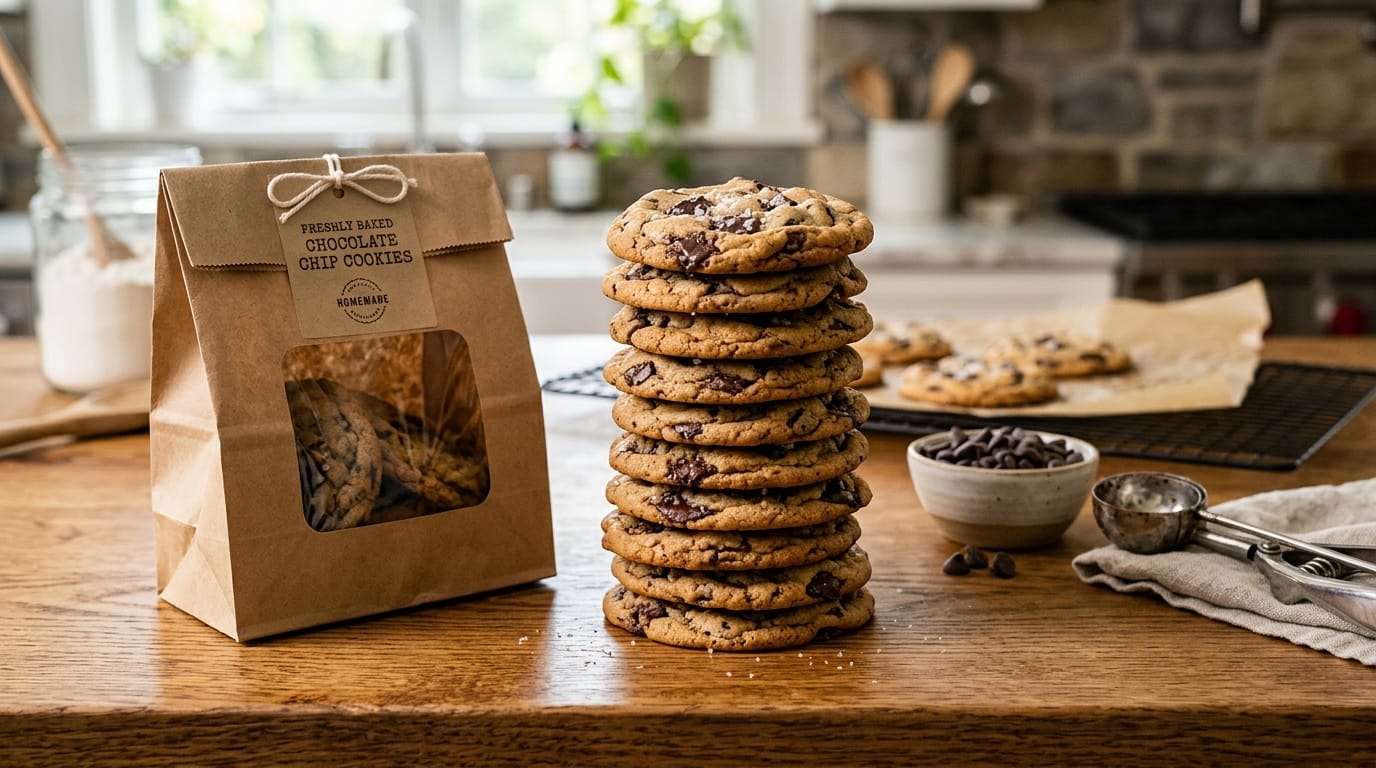
Twelve dollars. Ask around any market or baking group and that is the number you will hear most for a dozen chocolate chip cookies. It feels safe. Nobody flinches at it. But before you decide how much to charge for a dozen cookies, it is worth knowing what twelve dollars actually pays you for your afternoon.
Let’s find out with a real batch, costed line by line using the same steps as the free Recipe Pricing Calculator.
The batch: four dozen chocolate chip cookies
This is a classic recipe, doubled: 4½ cups flour (about 20 ounces), four sticks of butter, 1½ cups granulated sugar, 1½ cups packed brown sugar, four eggs, 2 teaspoons vanilla, 2 teaspoons each of baking soda and salt, and a full 24-ounce bag of semi-sweet chips. Scooped at a little under 2 ounces of dough each, it makes 48 generous cookies, or four dozen.
Step 1: ingredients, and the surprise line
Flour ($0.545 a pound), sugar ($1.019 a pound) and eggs ($2.27 a dozen) are the U.S. city averages the Bureau of Labor Statistics published for September 2026 (BLS). Butter is $3.96 a pound from the same BLS series (via FRED). Brown sugar, pure vanilla, chips, baking soda and salt are October 2026 shelf prices at a national grocer. Prices vary by region, so use your own.
- Flour, 20 ounces: $0.68
- Butter, 1 pound: $3.96
- Granulated sugar: $0.67
- Brown sugar (a 2-pound bag at $5.78): $2.10
- Eggs, 4: $0.76
- Pure vanilla, 2 teaspoons (from a $5.12 two-ounce bottle): $0.85
- Baking soda and salt: $0.04
- Chocolate chips, 24 ounces: $6.74
Ingredients: $15.80, or $3.95 a dozen, with each line rounded to the cent. Here is the surprise: the chocolate costs more than the butter, flour and sugar put together. If you upgrade to chopped bar chocolate or a premium chip, that one line can double, so price each flavor on its own rather than charging one rate for every cookie on the table.
Step 2: overhead and packaging
The calculator treats overhead as a percentage of ingredients. We use 20 percent, the top of its suggested 15 to 20 percent range for a home kitchen: $3.16 for oven time, parchment and wear on your sheet pans.
Each dozen goes into a kraft bag with a window (12 for $4.48, so $0.37 each) with a printed label ($0.22). That is $0.60 a dozen, or $2.38 for the batch.

Step 3: labor
Mixing takes 20 minutes, scooping 20, two rounds of baking with pan swaps and rotating about 40, cooling and bagging 30, labels 15 and cleanup 25. That is 2½ hours. At $17 an hour, labor is $42.50.
Track your own time for one batch. Most of us underestimate it, and the gap is usually the cleanup.
How much to charge for a dozen cookies: the math
$15.80 + $3.16 + $2.38 + $42.50 = $63.84 for four dozen, or $15.96 a dozen. That is break-even, with you paid $17 an hour and not a cent of profit.
Add a markup:
- 30 percent (the calculator’s default): $20.75 a dozen
- 50 percent: $23.94 a dozen
- 100 percent: $31.92 a dozen
A sensible range for this cookie is $21 to $24 a dozen. For singles at the market, the break-even is $1.33 a cookie and a 50 percent markup is about $2.00, so $2.50 each, or a dozen at a better per-cookie price, works well.
Twelve dollars a dozen does not pay for the cookies. It pays you about ten dollars an hour to bake them.Butter & Sage Market
What twelve dollars a dozen really pays
Take labor out and the rest of this batch costs $21.34. Four dozen at $12 brings in $48, which leaves $26.66 for your time. Divide by 2½ hours and you made $10.66 an hour, with no profit and nothing set aside for the day a tray burns.
That is the real reason the familiar number feels fine at first and exhausting by December. If this hits close to home, How to Price Your Baked Goods explains why your time, not your flour, is most of the price and how to start moving toward the right number, and The Simple Pricing Formula gives you the quick version for a busy market morning.

Know your real profit on every dozen
On the Maker plan, save each recipe once and see your true profit, with your time, overhead and costs all included. Every shop starts free on Starter.
Open your shop
Fresh. Local. Sustainable.
Decorated cookies are a different job
Swap the chocolate chips for a sugar cookie and royal icing and the ingredient line barely moves. The labor line is what explodes. Suppose decorating this same four dozen adds four hours of piping, flooding and drying time. At $17 an hour, that is another $68, or $17 more a dozen.
Break-even jumps to $32.96 a dozen before any markup, and a 50 percent markup puts it at about $49. Custom sets with themed designs and personalized names take longer still, which is why our guide to handling custom orders recommends a customization premium on top.
- Cost each flavor on its own, starting with your most expensive one
- Time a full batch, cleanup included
- Count the bag and the label, every time
- Pick your markup before market day, not at the table
- Recheck your numbers when butter or chocolate prices move
Run your own recipe through the calculator this week and compare it with what you charge now. What did you find? Share your number in the comments.

Keep reading
More from the market
How to Build a Thanksgiving Table from the Farmers Market
Most of Thanksgiving grows within an hour of your house. Here is what to buy at the market, what to reserve now,…
Read more
How to Fill Next Season’s CSA Shares Before Spring
How to fill CSA shares before spring: renew members in November, set early-bird deadlines, offer deposits and payment plans, and get SNAP…
Read more
How Much to Charge for Pies at the Holidays (A Real Apple Pie Cost Breakdown)
How much to charge for pies this holiday season? We cost six all-butter apple pies line by line, from apples to boxes…
Read more