
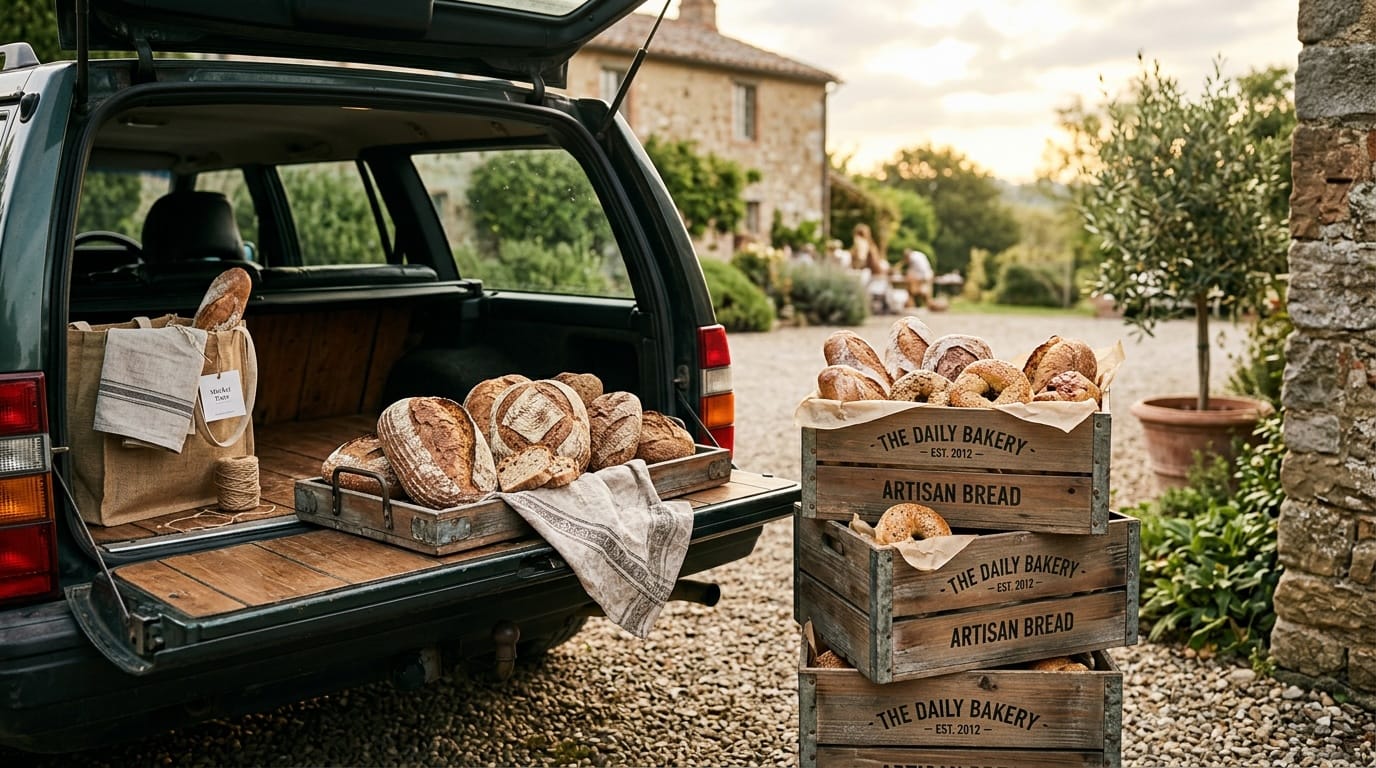

You were up at four. The bakes are perfect. And then somewhere between your driveway and the market you take a roundabout slightly too fast, and arrive to find the top tier of cupcakes leaning against the lid like a crowd at a barrier.
Almost nobody is taught this part. You learn to bake, and then you learn — expensively, one market at a time — how to move what you baked.
The three things the car does to your food
It moves. Not the driving so much as the stopping and the corners. Anything that can slide will, and anything stacked will shift.
It sweats. A warm bake in a closed container makes its own weather. Condensation collects on the lid, drips back down, and a crisp thing becomes a soft thing. This is what ruins cookies, crackers and anything with a sugar crust.
It gets hot, then cold. A car parked in morning sun hits temperatures that soften frosting and chocolate fast. Then you unload into a cold October morning and the surface goes dull and sets oddly.
Fix those three and almost everything else takes care of itself.
Cool it completely. Longer than you think.
This is the single biggest one, and it is the one people rush because it is four in the morning.
Anything packed warm will sweat. Bread needs to be fully cool through the middle, which for a big loaf is hours, not forty minutes. Cookies need to be cool and crisp before the lid goes on. Frosted things need the frosting fully set, ideally chilled firm.
If you are packing at 5am for a 7am market, the baking needed to finish the night before. The vendors whose product looks best on the table are almost always the ones who built cooling time into the schedule instead of stealing it.
For crisp things specifically: pack them with the container not quite sealed, or with a paper towel in the lid, and they stay crisp.
Crates and trays, not stacked boxes
The stackable bread crate is the piece of equipment that changes this job. Rigid, vented, square, and the whole point is that the weight of the crate above rests on the crate below rather than on your food.
Under that: sheet trays, or the flat lids of the crates, so that each layer is a shelf instead of a pile. Non-slip matting or a damp tea towel on each surface stops things skating.
For anything tall and unstable — layer cakes, decorated cookies, cupcakes — the rule is that nothing should be able to touch its neighbour. Cupcake inserts, dividers, or a box per item. If it can wobble into something, at some point it will.
Pack the car so the heavy, stable things go at the bottom and the fragile things go on top and flat. The footwell of a passenger seat is the calmest place in a car and is worth saving for the one thing that must not move.
What each kind of thing actually needs
Bread and rolls — cool completely, then paper or cloth, never sealed plastic, which softens the crust within the hour. Crates, loosely.
Cookies and crackers — cool and crisp, rigid container, layers separated with parchment, not airtight until they are properly cold.
Frosted cakes and cupcakes — chill until the frosting is firm, transport cold, individual support, and keep them out of the sun in the car. Buttercream in a warm car is a lost afternoon.
Pies and tarts — flat, on a rigid base, and not stacked. A pie carrier earns its price the first time.
Jars — they survive nearly anything except each other. Divided boxes or a towel between them; a chipped rim is unsellable.
What to keep in the car for the rest of the season
A crate of spares, because the fixable disasters are all small ones: extra parchment, a roll of paper towel, spare labels and a pen, a putty knife or offset spatula for repairing a smudge of frosting, a couple of clean tea towels, non-slip matting, and a cooler with two ice packs for anything that softens.
And leave ten minutes of slack in the schedule. Almost every arrival disaster I have heard about started with being late and driving like it.
Butter & Sage Market
Take orders before you load the car
Pre-orders through a shop page mean you know exactly what to bake and exactly what to pack — and the fragile things get handed over, not displayed.
Fresh. Local. Sustainable.
What is the piece of kit you would not go to market without? The bread crate converts everybody eventually, but I suspect there are better answers.



0 Comments