
Farm Stand Sign Ideas That Actually Make Cars Stop
Farm stand sign ideas backed by extension research: how big to letter, how many words fit at 40 mph, where to put the advance sign, and when to call the DOT.
 4 min read
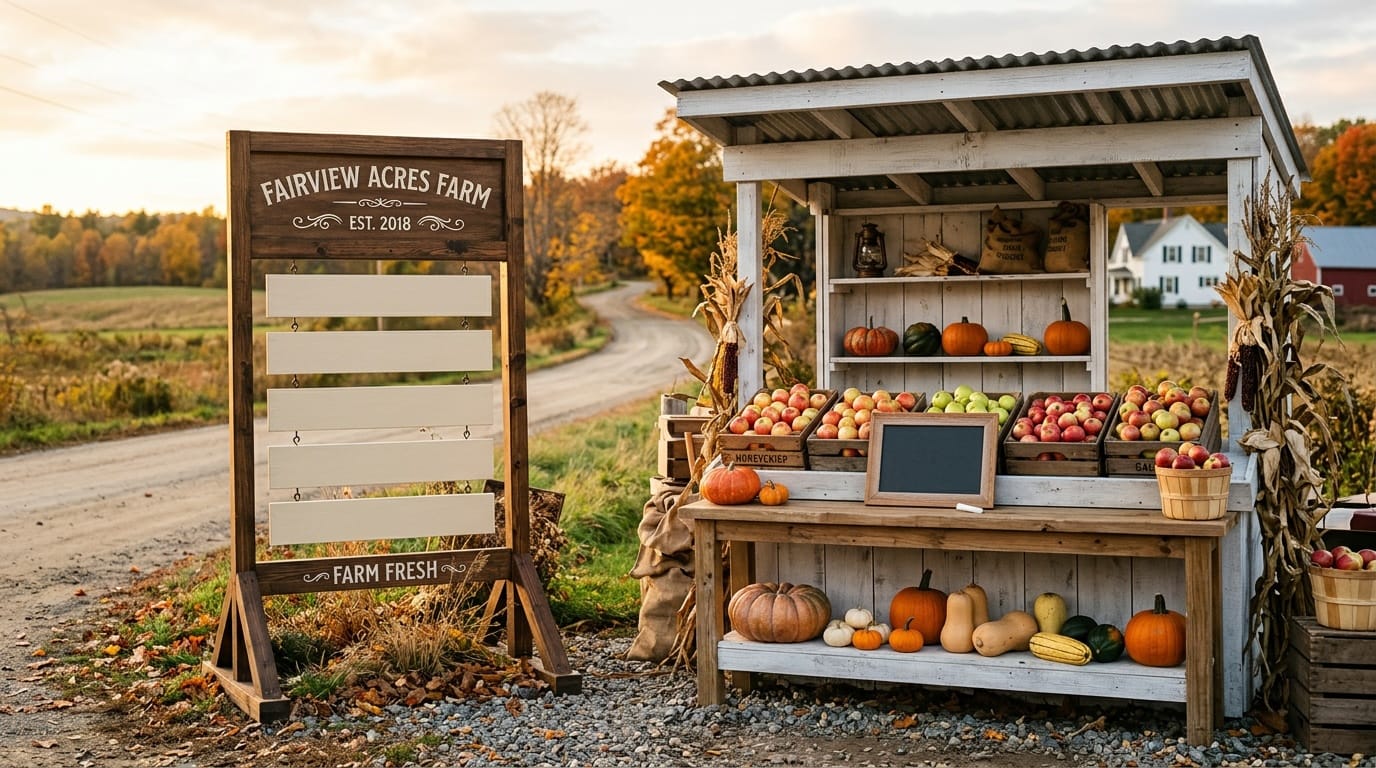
Picture the driver. She is doing 45, thinking about a school pickup, and your stand is a blur of color on the right. You have maybe two seconds to tell her what you sell and where to turn, and another few hundred feet for her to decide it is worth the brake pedal. The best farm stand sign ideas all come back to those two seconds.
We covered the basics of running a stand in Selling from a Farm Stand. This post is only about the signs, with the actual numbers on letter size, word count and placement from extension research, so you can stop guessing.
The numbers behind a readable roadside sign
The University of Tennessee’s Center for Profitable Agriculture published a practical guide, Creating Signage that Sells, and it is worth printing. A few figures from it change how you will build a sign.
Letter height. Its general rule is about 1 inch of letter height for every 30 feet of legibility distance. To be read from 200 feet, capital letters need to be close to 7 inches tall. University of Vermont Extension’s Vern Grubinger goes further in his fact sheet on farm signs, noting that at 40 mph most people can read fewer than a dozen words from 200 feet even with 7-inch letters, and suggesting roadside lettering closer to a foot and a half tall.
Word count. The Tennessee guide estimates that a driver at 40 mph can take in about 10 words from 200 feet, and fewer as speed increases. Drivers scan rather than read, so treat that as a ceiling.
Stopping room. Drivers need roughly 10 feet per mile per hour to slow safely, so about 450 feet on a 45 mph road. Grubinger says drivers need almost a quarter mile to decide whether to stop.
Farm stand sign ideas that actually make cars stop
The advance sign. One sign a few hundred feet before the stand, with the crop and a direction: “Sweet Corn, Next Right.” The Tennessee guide recommends a location cue like an arrow, a distance or “next right,” because a driver who is not told where to turn will not turn.
The one-crop headline. Grubinger’s examples are perfect: “Just-Picked Sweet Corn.” “Fresh Juicy Strawberries.” Name the thing people stop for in peak season, and change it as the season changes. In October that might be “Pumpkins and Apple Cider.”
The swap board. Build the main sign with a slot or hooks for interchangeable panels. Eggs, tomatoes, flowers, pie pumpkins: one panel each, hung when you have them and taken down when you do not. It keeps the sign truthful without repainting.
The open and closed flip. Nothing burns goodwill like turning in and finding an empty table. A hinged “Open” panel that folds shut when you close is cheap and earns trust.
The perpendicular sign. The Tennessee guide notes that signs set perpendicular to the road are easier to read than signs running parallel to it. If space allows, use a two-sided sign facing both directions of traffic.
The talking sign at the table. Once a car has stopped, the job changes. Grubinger suggests sharing a variety’s origin, how to use it or a short story about the farm. A small chalkboard with “Roasts beautifully” or “Picked this morning” does more selling than you would expect.
The roadside sign gets the car to stop. The sign on the table gets the second visit.Butter & Sage Market
Color, fonts and materials
High contrast wins. Among the combinations the Tennessee guide reports as most visible are black on yellow, black on white and yellow on black. The least visible was yellow on red. Grubinger recommends dark lettering on a light background with generous empty space around the words.
Keep the lettering plain. Thin fonts disappear at a distance, and script fonts can be hard to read at all. The Tennessee guide also suggests a capital first letter with lowercase after it, since that is easier to process at speed than all capitals.
For materials, the same guide points to exterior enamel on good plywood with a UV-protective clear coat. When a price changes, make a new card rather than crossing out the old one. A tidy sign signals a tidy stand.

Turn the cars that stop into members
The neighbor who pulls over for tomatoes is your best CSA prospect. We are building CSA tools with founding farms, plus a farm-share map families can search.
Join the founding farms
Fresh. Local. Sustainable.
Check the rules before you dig a post hole
Sign rules vary a lot by state, county and road. A sign on a state highway right-of-way can fall under your state department of transportation, while county roads and town limits often have their own sign or zoning rules. The Tennessee guide’s advice applies everywhere: check with your state DOT for state routes and with local planning or road departments for city and county roads.
Whatever the rules say, never place a sign where it blocks a driver’s view of the road or an intersection. Grubinger makes the same point, and it is the one rule that does not vary.
- Call your county planning or zoning office about on-property signs.
- Ask your state DOT before putting anything near a state highway.
- Get permission in writing before using a neighbor’s corner for an advance sign.
- Keep every sign clear of sight lines at driveways and intersections.
Make the stand look like the sign promised
The sign makes the promise and the stand keeps it. Abundant, well-lit displays, clear prices and a clean table turn a curious first stop into a weekly habit. Many of the ideas in our guide to market display ideas work just as well at the end of a driveway.

Keep reading
More from the market
How to Fill Next Season’s CSA Shares Before Spring
How to fill CSA shares before spring: renew members in November, set early-bird deadlines, offer deposits and payment plans, and get SNAP…
Read more
How to Price CSA Shares So the Farm Actually Gets Paid
How to price CSA shares from your real costs: a worked season budget with your own pay, packaging, card fees and a…
Read more
What’s in a Winter CSA Share, and Is It Worth Joining?
What a winter CSA share really holds, from storage roots and squash to tunnel-grown greens, how pickup changes after frost, and the…
Read more