
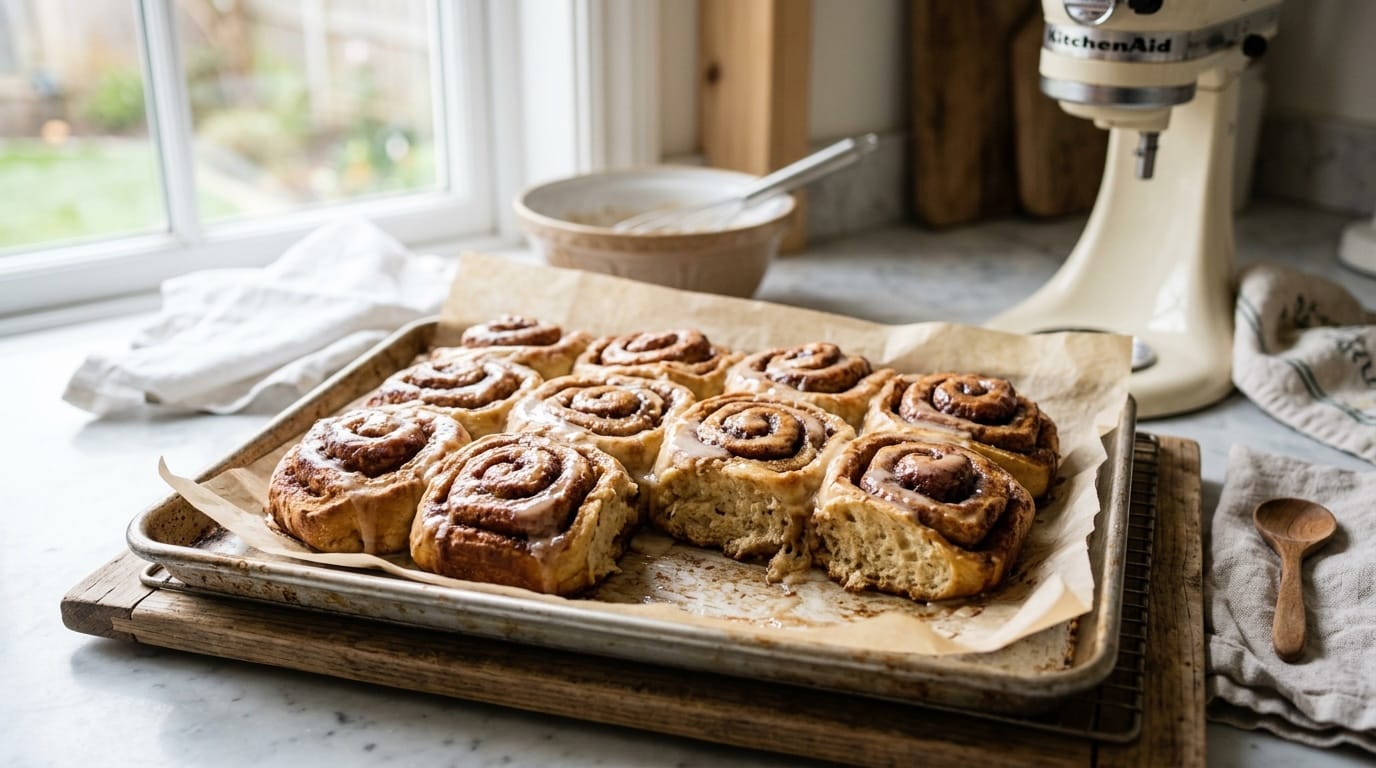

There is a bakery table at my market where the cinnamon rolls sell out by nine. Not nine-thirty. Nine. People walk directly there from the parking lot, and half of them are not even pretending to shop first. I asked her once what the trick was, and she said, mostly to be nice, "sourdough and patience."
She was not being coy. That is genuinely the whole thing.
Why sourdough belongs in a cinnamon roll
A conventional cinnamon roll is sweet, and then it is over. A sourdough roll has a quiet sourness underneath the sugar that keeps the whole thing from being one flat note — it tastes like something instead of just tasting sweet. The tang plays against the brown sugar and cinnamon the same way buttermilk plays against a biscuit.
The long fermentation also does real structural work. Overnight, the starter's acids and enzymes are slowly reorganizing the dough — developing gluten without kneading, breaking down starches into flavor, and producing a crumb that stays soft for a day and a half instead of going stale by lunch. Which brings us to the market question.
Why they hold up on a market table
If you are a cottage food vendor, staling is your real enemy. A conventional enriched roll baked Friday night is noticeably tired by Saturday noon. A sourdough version, because of the acidity and the slow ferment, holds its texture significantly longer — which means the roll a shopper buys at eleven is close to the roll you pulled out of the oven at six.
Sourdough is also, right now, one of the strongest search terms in food. Shoppers actively look for it and will pay a premium for it, and a hand-lettered sign that says SOURDOUGH does more work at a booth than almost any other single word. If you have a starter and you are already selling bread, this is a high-margin second product built from ingredients you have.
If you are thinking about the business side of that, we walked through it in how to start selling sourdough at the farmers market.
The one technique that decides everything: your starter's timing
This dough is leavened by your starter and nothing else, so the starter has to be genuinely active when it goes in. Not "fed this morning and now sitting there" — active. Feed it four to eight hours ahead and use it when it has roughly doubled, is domed on top, and passes the float test: a spoonful dropped into a glass of water sits on the surface instead of sinking.
Put a sluggish starter into an enriched dough and you will get a dense, sad, faintly sour brick, and you will blame the recipe. It was the starter. It is almost always the starter.
The second thing worth knowing: butter slows fermentation. That is why this dough gets its first rise before it is shaped and then a long cold night in the refrigerator, and why the morning rise takes an hour or two in a warm kitchen rather than twenty minutes. Enriched sourdough is not fast. It is just mostly unattended, which is a different thing.
Make it yours
Apple butter swirl. Spread a thin layer of apple butter under the cinnamon sugar. It is the single best fall variation, and if you are a vendor already making apple butter, it is free product development.
Brown butter and cardamom. Brown the filling butter and add a half teaspoon of ground cardamom. Suddenly they are Scandinavian and everyone at your table wants to know what you did.
Maple pecan. Swap the icing for a maple glaze and press toasted pecans into the tops while they are still warm. This one photographs beautifully, which matters more than we like to admit.
Cream cheese vs. simple glaze. Cream cheese icing tastes better and needs refrigeration; a powdered sugar and milk glaze holds at room temperature all morning. For a market table in warm weather, the simple glaze is the practical answer.
Orange and cranberry. Orange zest in the dough, dried cranberries in the filling, orange juice in the glaze. This is the holiday market version.
What to buy at the market for these
Good butter from a local creamery is the ingredient that shows up most in the finished roll — it is most of the flavor of the filling and a fair share of the dough. Farm eggs give the dough a deeper color. And if there is a spice vendor at your market, buy the cinnamon from them; the difference between fresh cinnamon and the jar that has been in your cabinet since 2022 is not subtle.
A note on the pan and the pull-apart
Bake them close together in a round or square pan so the sides stay soft and they pull apart in a sheet. If you want crisper edges on every roll — which some people strongly prefer — space them out on a sheet pan instead. Neither is wrong. It is a texture argument that families have been having for generations and we are not going to settle it here.
If you make these, we would love to see them. Tag @butterandsagemarket so we can find you — and if you would rather buy your cinnamon rolls than make them at six in the morning, that is an entirely respectable position. Find a local baker near you on Butter & Sage Market and let someone else do the overnight rise.
Overnight Sourdough Cinnamon Rolls
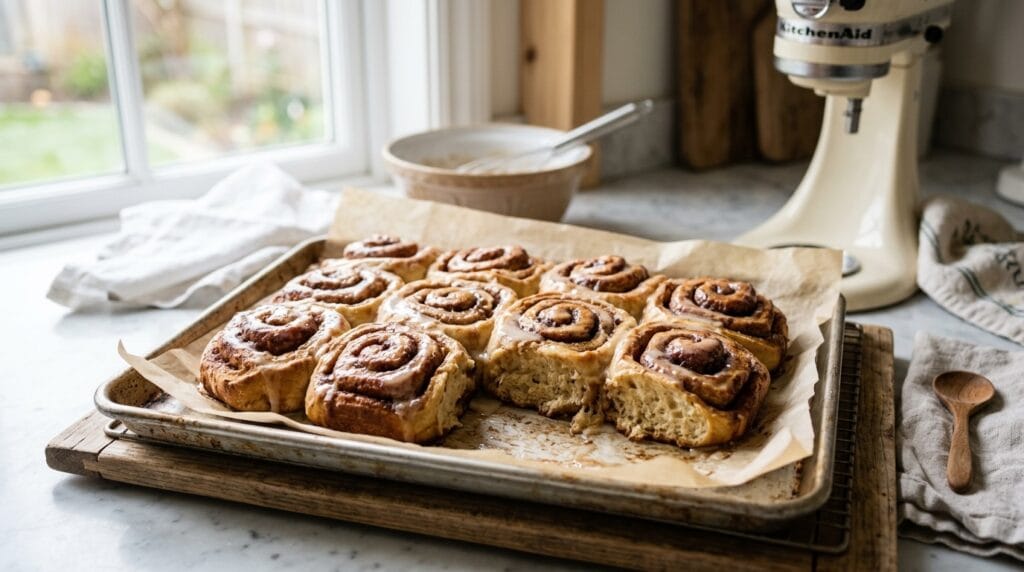
Soft, tangy cinnamon rolls leavened entirely with active sourdough starter. A long cold rise builds flavor overnight and keeps them fresh far longer than a conventional roll.
Ingredients
Dough
Filling
Glaze
Instructions
Evening — mix and first rise
- Feed your starter 4 to 8 hours before you plan to mix. It is ready when it has roughly doubled, domes on top, and a spoonful floats in a glass of water. This is the single most important step — a sluggish starter will not lift an enriched dough.
- In a large bowl or stand mixer, whisk together the starter, warm milk, egg, egg yolk and granulated sugar until smooth.
- Add the flour and salt and mix on low (or stir with a sturdy spoon) until no dry flour remains. Cover and rest 30 minutes.
- Add the softened butter a few pieces at a time, mixing on medium-low until each addition disappears before adding more. The dough will look broken and greasy for several minutes — keep going. It will come together into a smooth, glossy, slightly tacky dough. Total mixing time is 8 to 12 minutes.
- Cover and let rise at warm room temperature (about 76°F) for 4 to 6 hours, folding the dough over itself once an hour for the first three hours. It should grow by about 50 percent and feel puffy and alive, not doubled.
Shape and cold retard
- Turn the dough onto a lightly floured surface and roll into a rectangle roughly 16 by 12 inches, with a long side facing you.
- Spread the very soft filling butter edge to edge, leaving a 1-inch bare strip along the far long edge. Stir the brown sugar, cinnamon and salt together and scatter evenly over the butter, pressing it in gently with your palm.
- Roll up snugly from the long edge nearest you, finishing at the bare strip. Pinch the seam closed and rest the log seam-side down for 5 minutes.
- Cut into 12 equal rolls using unflavored dental floss or a very sharp serrated knife — slide the floss under the log, cross the ends over the top and pull. Arrange cut-side up in a buttered 9x13-inch pan or two 9-inch rounds, leaving a little space between.
- Cover tightly and refrigerate 8 to 14 hours. This cold night is where the flavor and the keeping quality come from.
Morning — rise and bake
- Take the pan out of the refrigerator and let the rolls finish rising in a warm spot for 1 1/2 to 3 hours, until visibly puffed, touching each other, and jiggly when you nudge the pan. Enriched sourdough is slow — do not rush this by baking early.
- Heat the oven to 350°F with a rack in the center.
- Bake 26 to 30 minutes, until deep golden on top and the center rolls read 190°F on an instant-read thermometer. Tent with foil at 20 minutes if the tops are browning fast.
- Cool in the pan 15 minutes. Whisk the glaze ingredients until pourable and spoon over the warm rolls.
Notes
SCHEDULE: Mix around 4 p.m., shape and refrigerate by 9 p.m., bake at 9 a.m. For a market bake, shift everything four hours earlier.
STORAGE: Room temperature in an airtight container for up to 2 days — they hold noticeably better than conventional rolls. Refrigerate up to 5 days, or freeze baked and unglazed for 2 months. Reheat 8 minutes at 300°F.
MAKE AHEAD FOR MARKET: Freeze the shaped, unrisen rolls in the pan. Thaw overnight in the refrigerator, then finish the warm rise and bake as written.
VARIATIONS: Spread a thin layer of apple butter under the cinnamon sugar; brown the filling butter and add 1/2 tsp ground cardamom; swap in a maple glaze with toasted pecans; or add orange zest to the dough and dried cranberries to the filling.
GLAZE CHOICE: This powdered sugar glaze holds at room temperature all morning, which makes it the practical choice for a market table. Cream cheese icing tastes richer but needs refrigeration.



0 Comments