
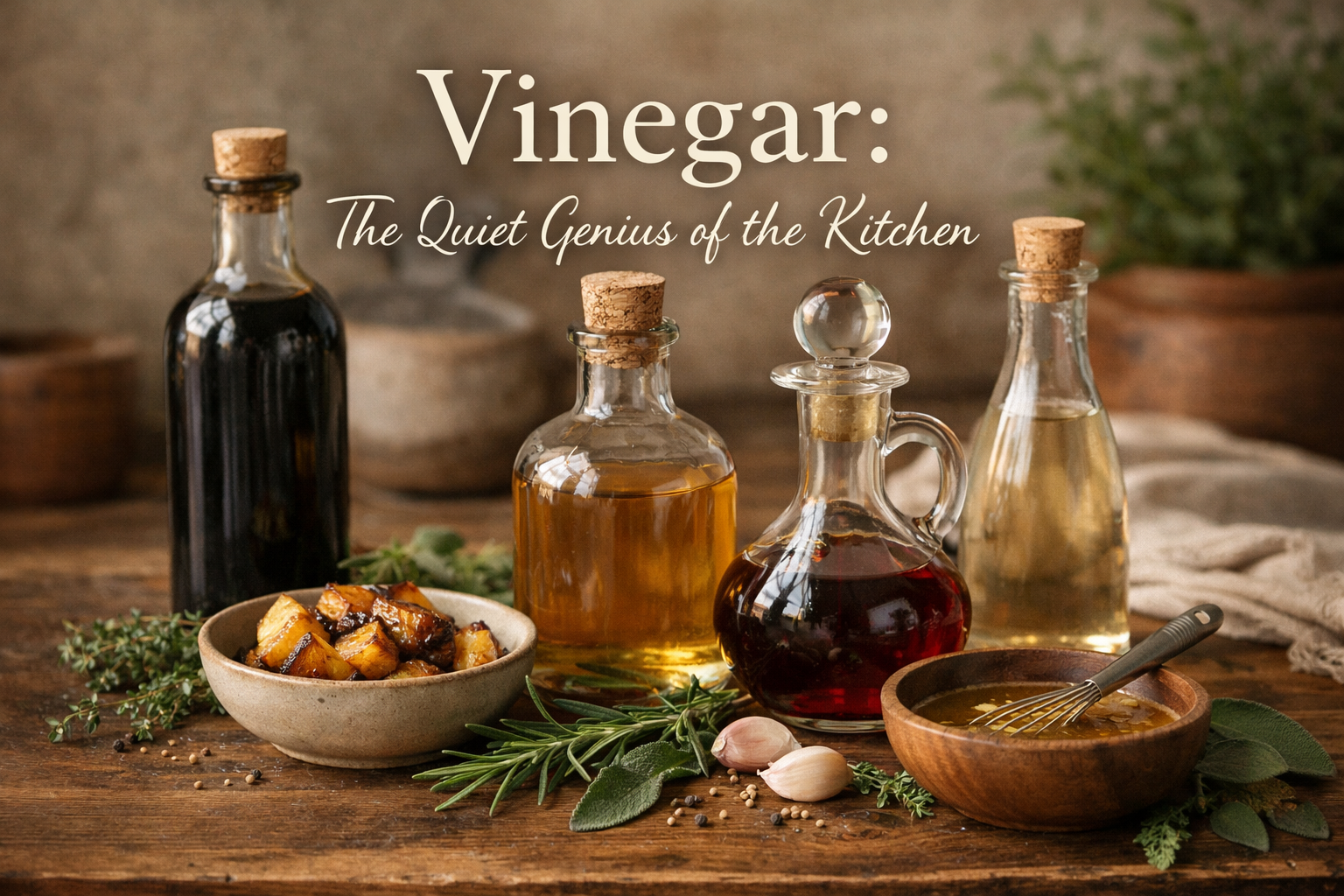
There’s a moment every good cook knows well.
You taste a dish.
It’s seasoned. It’s rich. It’s technically fine.
But something is missing.
You add a pinch of salt. Nothing changes.
You swirl in a little butter. Better, but still dull.
Then—almost as an afterthought—you add a splash of vinegar.
Suddenly, the dish wakes up.
That humble bottle tucked into the corner of your pantry isn’t just a condiment. Vinegar is one of the most powerful—and most overlooked—ingredients in a home cook’s kitchen. It brings brightness where food feels heavy, balance where flavors blur together, and contrast where richness needs relief.
And yet, for many home cooks, vinegar is an afterthought. It’s something you use for salad dressing, quick pickles, or cleaning the coffee maker. This article is an invitation to bring vinegar into the spotlight—to understand where it comes from, why it matters, and how a small splash can transform the way you cook.
A Long, Tangy History
Vinegar is ancient—older than cookbooks, older than culinary schools, and possibly older than civilization itself. Long before anyone wrote down a recipe, someone discovered that wine left exposed to air didn’t just spoil. It transformed.
The word vinegar comes from the French vin aigre, meaning “sour wine,” and that simple description still holds true. Vinegar is what happens when alcohol is allowed to continue its journey instead of stopping at wine or cider.
Across history, vinegar has quietly threaded itself through kitchens and cultures. Ancient Babylonians flavored it with fruits and herbs. Roman soldiers drank diluted vinegar for refreshment. In Asia, rice vinegars became foundational to regional cuisines, while in Europe vinegar became essential for preservation, seasoning, and everyday cooking.
Food historians and culinary scientists like Harold McGee have long documented vinegar’s role not just as a preservative, but as an intentional flavoring agent used centuries before modern culinary theory existed.
How Vinegar Is Made (Without the Science Lecture)
At its heart, vinegar is a story of transformation. It begins with something sweet—fruit, grain, or rice—and ends with something sharp, complex, and alive.
First, yeast converts natural sugars into alcohol, creating wine, cider, or beer. Then, when oxygen enters the picture, beneficial bacteria convert that alcohol into acetic acid. That acetic acid is what gives vinegar its signature tang.
Good vinegar takes time. Traditional methods allow fermentation to happen slowly, developing depth and character. Industrial vinegars, on the other hand, are often rushed into existence, producing sharpness without nuance. This distinction is well documented by organizations like the Slow Food movement and culinary testing institutions such as America’s Test Kitchen.
Vinegar as a Global Ingredient
Every cuisine on earth figured out vinegar, because every cuisine needed acid.
From wine-based vinegars in Mediterranean kitchens to rice vinegars in East Asia, vinegar evolved to reflect local ingredients and cooking styles. Italian balsamic vinegars developed sweetness and richness through aging. Spanish sherry vinegar took on nutty depth. Apple cider vinegar carried the fruitiness of the harvest.
When you cook with vinegar, you’re cooking with centuries of accumulated knowledge—something chefs and food writers frequently highlight when discussing traditional flavor balance across cultures.
Why Vinegar Belongs in Everyday Cooking
If salt helps food taste more like itself, acid helps food taste alive.
Vinegar sharpens flavors, balances fat, and keeps rich dishes from feeling heavy. It wakes up your palate and makes your mouth water, which is exactly why food seasoned with acid feels more satisfying.
Samin Nosrat explains this beautifully in Salt, Fat, Acid, Heat, where acid is described as the element that “brightens and balances” dishes the way contrast brings life to a painting.
Think of cooking the way an artist thinks about painting. Without contrast, everything blurs together. Vinegar is that contrast in cooking—the bright stroke that makes rich, slow-cooked flavors stand out.
The Places Vinegar Works Quietly Behind the Scenes
Many home cooks use vinegar only at the beginning of a recipe, but some of its most powerful work happens at the very end.
After braising meat for hours, flavors deepen but acidity fades. A small splash of vinegar at the finish brings everything back into focus. Creamy sauces benefit from a few drops to keep them from feeling heavy. Soups and stews that taste “fine but flat” almost always need acid more than salt—a principle frequently reinforced in professional recipe testing kitchens like America’s Test Kitchen and Serious Eats.
Roasted vegetables, beans, lentils, and long-simmered dishes all benefit from a gentle lift of acidity just before serving.
The Vinegars You Already Know (Even If You Don’t Realize It)
Even if vinegar hasn’t felt like a regular part of your cooking, it’s already present in many familiar dishes. Red wine vinegar defines classic vinaigrettes. Balsamic vinegar deepens roasted vegetables and pan sauces. Apple cider vinegar balances coleslaw and barbecue sauce. Rice vinegar is essential for sushi rice and countless Asian dishes.
These flavors are familiar because they work. Vinegar has been quietly making classic recipes better for generations.
Why the Quality of Vinegar Matters
Not all vinegars deserve equal space on your shelf.
Well-made vinegar starts with real ingredients and slow fermentation, resulting in balance and complexity. Lower-quality vinegars are often made from distilled alcohol and tend to be harsh and one-dimensional.
Culinary experts—including those at Slow Food and Serious Eats—consistently emphasize that better vinegar doesn’t need to be expensive, but it should be thoughtfully produced.
Building a Vinegar Pantry That Actually Gets Used
A thoughtful vinegar pantry doesn’t need to be large. A few well-chosen bottles can cover most cooking needs and encourage you to reach for vinegar more often.
A red wine vinegar for everyday savory cooking, apple cider vinegar for versatility, rice vinegar for gentle acidity, balsamic vinegar for roasting and finishing, and sherry vinegar for depth will serve most home cooks beautifully.
Learn More from the People Who Know Flavor Best
If vinegar has sparked your curiosity, these resources are trusted, respected, and deeply informative:
Samin Nosrat – Salt, Fat, Acid, Heat
https://www.saltfatacidheat.comHarold McGee – On Food and Cooking
https://www.haroldmcgee.comSerious Eats – Vinegar & Acid in Cooking
https://www.seriouseats.comAmerica’s Test Kitchen – Understanding Acid
https://www.americastestkitchen.comSlow Food Foundation – Traditional Vinegar Production
https://www.slowfood.comThe Oxford Companion to Food (for historical context)
https://global.oup.com/academic/product/the-oxford-companion-to-food-9780199677337
These are the kinds of references professional cooks rely on—and home cooks benefit just as much.
A Gentle Nudge to Start Splashing
Vinegar isn’t there to make your food sour. It’s there to make it balanced.
It’s the final adjustment that turns “good” into “memorable.”
The brightness that cuts through richness.
The contrast that makes flavors feel intentional.
So next time a dish tastes almost right, don’t reach for more salt. Reach for the vinegar. Add a few drops. Taste again.
That’s not cheating.
That’s cooking.
And once you start using vinegar with intention, you’ll wonder how your kitchen ever worked without it.










0 Comments