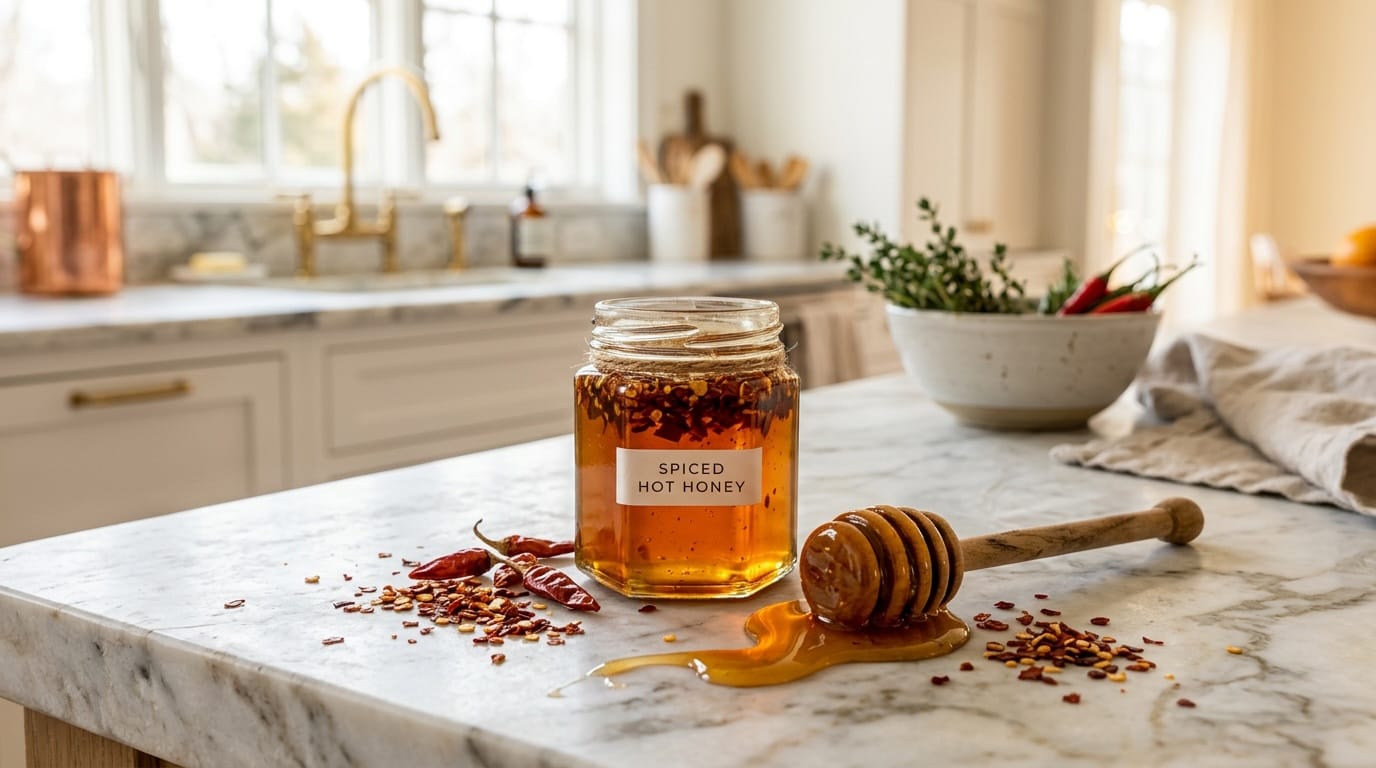

Hot honey has officially gone from "niche chef thing" to "the jar everyone gives as a gift and puts on everything." Pizza, fried chicken, cheese boards, roasted vegetables, scrambled eggs, vanilla ice cream. If it's food, someone has already drizzled hot honey on it and been glad they did.
The commercial versions are fine. The local version you make yourself — with a good raw honey base from a beekeeper you know, and the exact heat level you want — is better. And if you're a cottage food vendor, this is one of the most giftable, most sellable products you can put on your market table. The recipe takes ten minutes. The jar sells for $10–12. The shelf life is essentially indefinite.
Why Hot Honey Is Such a Good Cottage Food Product
Input costs are low — a cup of raw local honey, a tablespoon of quality chili flakes, a clean glass jar. Output: a product that sells for $8–12 for a standard jar, $5–6 for a two-ounce gift size. Margins are strong. The product never goes bad. And it sells through samples almost instantly: set out a small dish with a cracker at your market table and let people try it. They taste it and immediately think of three things they want to put it on. That mental picture closes the sale.
The Honey Matters Most
Everything else is adjustable — the chili variety, the heat level, the steeping time. The honey is where you invest. Raw local honey has flavor complexity that commercial honey doesn't: floral notes, subtle acidity, mineral quality that plays against the heat in interesting ways. If you have a beekeeper at your local farmers market, that's your honey source. Most successful hot honey vendors settle on two or three varieties at different heat levels — mild, medium, hot — creating an easy upsell and letting buyers find their preference.
Labeling for Cottage Food Vendors
Your label needs: your name and address, "Hot Honey" as the product name, a full ingredient list, net weight, and your state's required cottage food disclaimer. Hot honey made with shelf-stable dried chili flakes typically qualifies as a cottage food product in most states — but confirm with your state's agriculture department before selling.
If you start selling hot honey at your market and it becomes your best-selling product — which it might, because it often does — come tell us about it on Butter & Sage Market. That's exactly the kind of story we're here for.
Butter & Sage Market
Ready to List Your Hot Honey (and Everything Else)?
Butter & Sage Market is the online marketplace built for cottage food vendors. Open your shop, list your products, and get discovered by local buyers between market Saturdays.
Fresh. Local. Sustainable.
Small-Batch Hot Honey
Two ingredients, ten minutes, a jar that keeps indefinitely. The simplest, most giftable thing you can make — and if you're a cottage food vendor, it may become your best-selling product.
Ingredients
Instructions
- Combine honey and red pepper flakes (and chipotle or vinegar if using) in a small, heavy-bottomed saucepan.
- Warm over low-medium heat, stirring occasionally, until honey just begins to bubble at the edges — about 3-5 minutes. Do not boil. The goal is infusion, not caramelization.
- Remove from heat and steep for 5 minutes for mild-medium heat, or up to 15 minutes for spicier result. Taste and adjust.
- Strain through a fine-mesh strainer into a clean, dry glass jar for clear honey, or leave flakes in for more heat and visual appeal. Both versions sell well at markets.
- Let cool completely before sealing the jar. Label with all required cottage food information if selling commercially.

0 Comments