

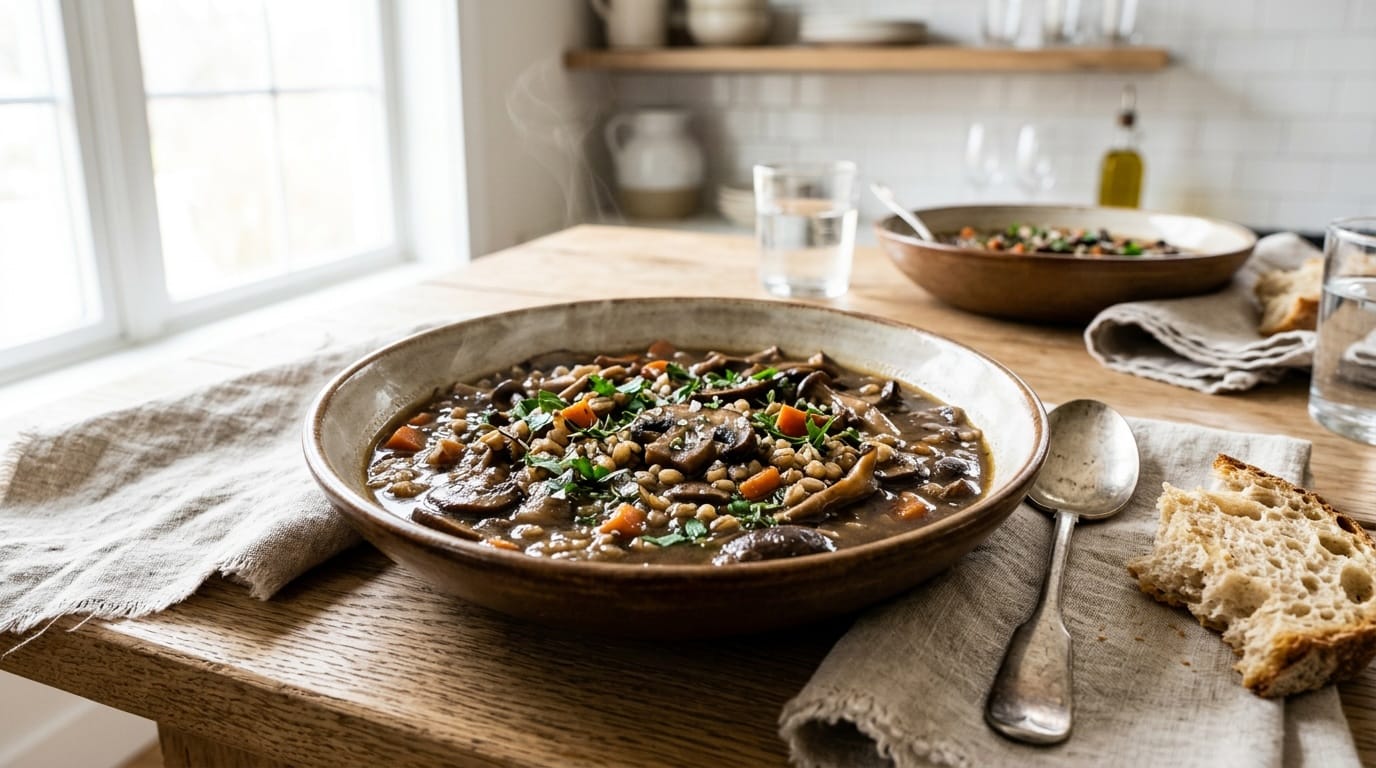
There is one morning every year — usually the last week of August, sometimes the first week of September — when you step outside and the air has changed. It is not cold. It is just no longer warm, and something in you immediately wants soup.
This is the one to make. Not because it is fancy, but because it is the first soup of the year that tastes like it took all day and did not.
The Mushroom Table You Have Been Walking Past
Almost every farmers market has a mushroom grower, and almost nobody stops. The tomatoes are prettier, the peaches smell better, and mushrooms sit there in their brown paper bags looking like homework.
They are, in fact, the best value at the market. Mushroom growers usually sell mixed bags — a few oysters, some shiitakes, whatever came off the blocks that week — and the mix is far more interesting than the single variety of cremini at the grocery store. They are also grown indoors, which means the mushroom grower is one of the few vendors who is there in March and there again in November.
Ask what is freshest. Ask if they will make you a mixed bag. Ask what they cook with at home. Mushroom growers are chronically under-consulted and they will talk your ear off in the best possible way.
The pearl barley is the other half of this. It is inexpensive, keeps in the pantry forever, and cooks right in the pot, releasing enough starch to thicken the soup on its own. No cream, no roux, no blender. It just gets silkier as it cooks.
The Technique That Makes or Breaks This Soup
Almost everything good in this pot comes from one step: browning the mushrooms properly before anything else goes in.
Here is what goes wrong. Most of us add mushrooms to the pan, immediately salt them, and start stirring. Salt pulls water out, the pan floods, and the mushrooms sit there simmering in their own liquid until they turn gray and rubbery. They are cooked, technically. They just do not taste like anything.



Instead: hot pan, real fat, mushrooms in a single layer, and then leave them alone. Four or five minutes without touching them. Let them sit still and take on color. Stir once, brown the other side, and only then add salt. What you are after is that deep, almost meaty flavor that comes from actual browning, and it is the entire difference between a soup with mushrooms in it and a mushroom soup.
Two other small moves do a lot of quiet work. A tablespoon of soy sauce in the pot — nobody will taste soy sauce, everybody will notice the savory depth. And a splash of sherry vinegar at the very end, off the heat. Taste the pot before and after you add it. It is like someone turned the lights on.
Make It Yours
Make it heartier. Brown a half pound of Italian sausage or diced pancetta at the beginning and set it aside with the mushrooms. Or drop a parmesan rind into the simmer and fish it out at the end.
Make it greener. A few handfuls of chopped kale, chard, or spinach stirred in during the last five minutes turns this from a starter into a full dinner, and early-fall greens at the market are excellent right now.
Make it gluten-free. Short-grain brown rice does the job with a similar simmer time. Cooked wild rice stirred in at the end works too, and it looks beautiful.
Make it richer. A splash of cream or a spoonful of crème fraîche stirred into each bowl is not traditional and is completely wonderful.
The Second-Day Rule
This soup is better tomorrow. That is not a consolation prize — it is the actual plan. The barley keeps softening, the flavors settle into each other, and the whole thing goes from good to genuinely excellent overnight.
It will also thicken considerably in the refrigerator, to the point where it is closer to a stew. Add a splash of stock when you reheat it, taste, and add salt again. Cold food needs more seasoning than you think.
Make it on a Sunday when the air first turns. Eat a bowl standing at the stove because you cannot wait. Then eat the rest of it on Tuesday when the week has gotten away from you and there is already dinner in the fridge.
If you came home with more than mushrooms, our guide to building meals around your market haul all week will help the rest of the bag earn its keep.
Made it? Tag @butterandsagemarket — we want to see the bowl. And if your market has a mushroom grower worth knowing about, tell us in the comments so your neighbors can find them too.
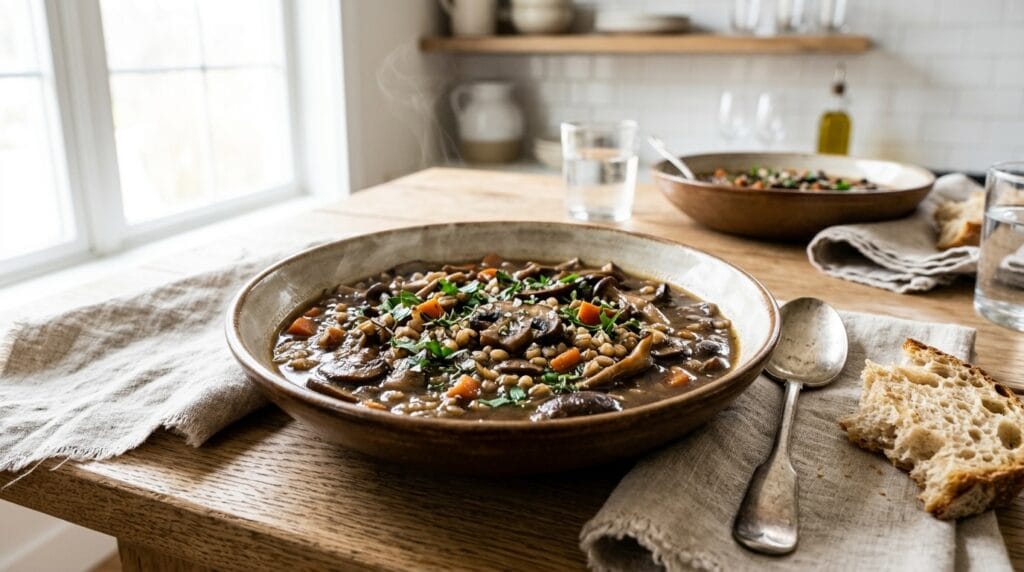
Farmers Market Mushroom and Barley Soup
A deeply savory, gently chewy soup built on mixed market mushrooms, pearl barley, and fresh thyme. Vegetarian as written, better on the second day, and the first soup worth making when the mornings turn.

Ingredients
The Mushroom Broth
The Soup
To Finish
Instructions
Start the Broth
- Put the dried mushrooms in a heatproof bowl, pour the boiling water over them, and let them sit for 20 minutes while you prep everything else. This is doing more work than it looks like.
- Lift the softened mushrooms out with a fork, chop them roughly, and set aside. Pour the soaking liquid carefully into a measuring cup and stop before the gritty last inch. Keep that liquid — it is the backbone of the soup.
Build the Base
- Heat 2 tablespoons of the olive oil and the butter in a large heavy pot over medium-high heat until the butter stops foaming.
- Add the fresh mushrooms in a single layer and then leave them completely alone for 4 to 5 minutes. Do not stir, do not salt them yet. They need to sit still and brown, and salting early pulls out water and steams them instead.
- Stir once, cook another 4 to 5 minutes until deeply browned at the edges and reduced by about half. Season lightly with salt now, then scrape the mushrooms onto a plate.
- Add the remaining tablespoon of oil to the pot and lower the heat to medium. Add the onion, carrots, and celery with a pinch of salt and cook 7 to 8 minutes until soft and just beginning to color, scraping up the browned bits as you go.
- Add the garlic and cook 1 minute until fragrant. Stir in the tomato paste and cook 2 minutes more, until it darkens from red to brick and smells sweet rather than sharp.
Simmer
- Add the barley and stir to coat it in the vegetables and paste. Toast for 1 minute.
- Pour in the reserved mushroom soaking liquid, the stock, the chopped rehydrated mushrooms, thyme, bay leaves, and soy sauce. Scrape the bottom of the pot thoroughly.
- Bring to a boil, then reduce to a bare simmer, cover partially, and cook 40 to 45 minutes, stirring occasionally, until the barley is tender with a gentle chew and the soup has thickened noticeably.
- Return the browned mushrooms to the pot and simmer 5 minutes more to bring everything together.
Finish
- Fish out the bay leaves and thyme stems. Stir in the vinegar — this is the step that wakes the whole pot up, so taste before and after and notice the difference.
- Season with salt and pepper, then let the soup sit off the heat for 10 minutes before serving. Stir in the parsley and serve with crusty bread and a hard cheese for grating over the top.
Notes
MAKE IT HEARTIER: Brown a half pound of Italian sausage or diced pancetta at the start and set it aside with the mushrooms. A parmesan rind dropped into the simmer adds real depth. A handful of chopped kale or chard stirred in at the end makes it a full meal.
GLUTEN-FREE: Swap the barley for 1 cup of farro-free grains such as short-grain brown rice (simmer 45 minutes) or 1.5 cups of cooked wild rice stirred in at the end. Use tamari instead of soy sauce.
FREEZING: Freezes well for 3 months, though the barley softens. Freeze in portions and thaw overnight in the refrigerator.
MUSHROOM NOTE: A mix is better than any single variety. Cremini give body, oysters give silkiness, shiitakes give savory depth. If your market has a mushroom grower, ask what is freshest — they will often make you a mixed bag.

Keep reading
More from the market
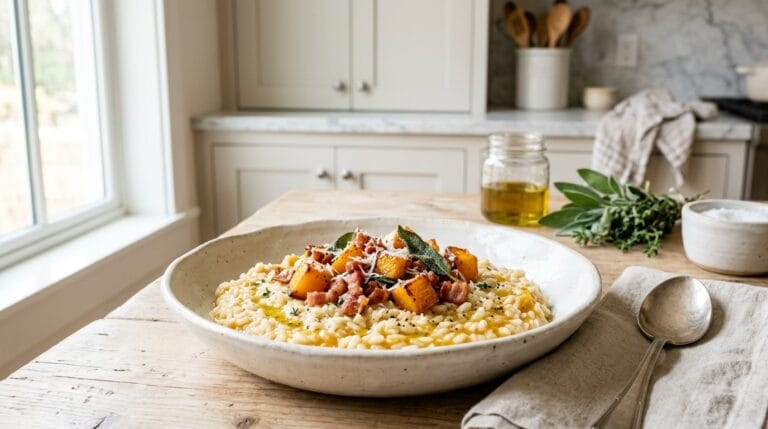
Butternut Squash Risotto with Crispy Pancetta
Half the squash melts into the rice, half stays roasted and whole. The two-texture trick that stops butternut risotto tasting like sweet…
Read more
Savory Sweet Potato and Caramelized Onion Galette with Sage
Sweet potatoes, onions cooked down slow, and fried sage on a free-form crust. A savory galette that turns three cheap market vegetables…
Read more
Kale and White Bean Stew with Sausage
One pot and forty minutes. Sausage, creamy white beans and a whole bunch of market kale, with the vinegar trick that stops…
Read more