CSA Box or Farmers Market? How to Choose What Actually Fits Your Household
CSA box or farmers market? A practical comparison of cost, flexibility, variety, and time — plus how to tell which one actually fits how your household cooks.
 1 min read
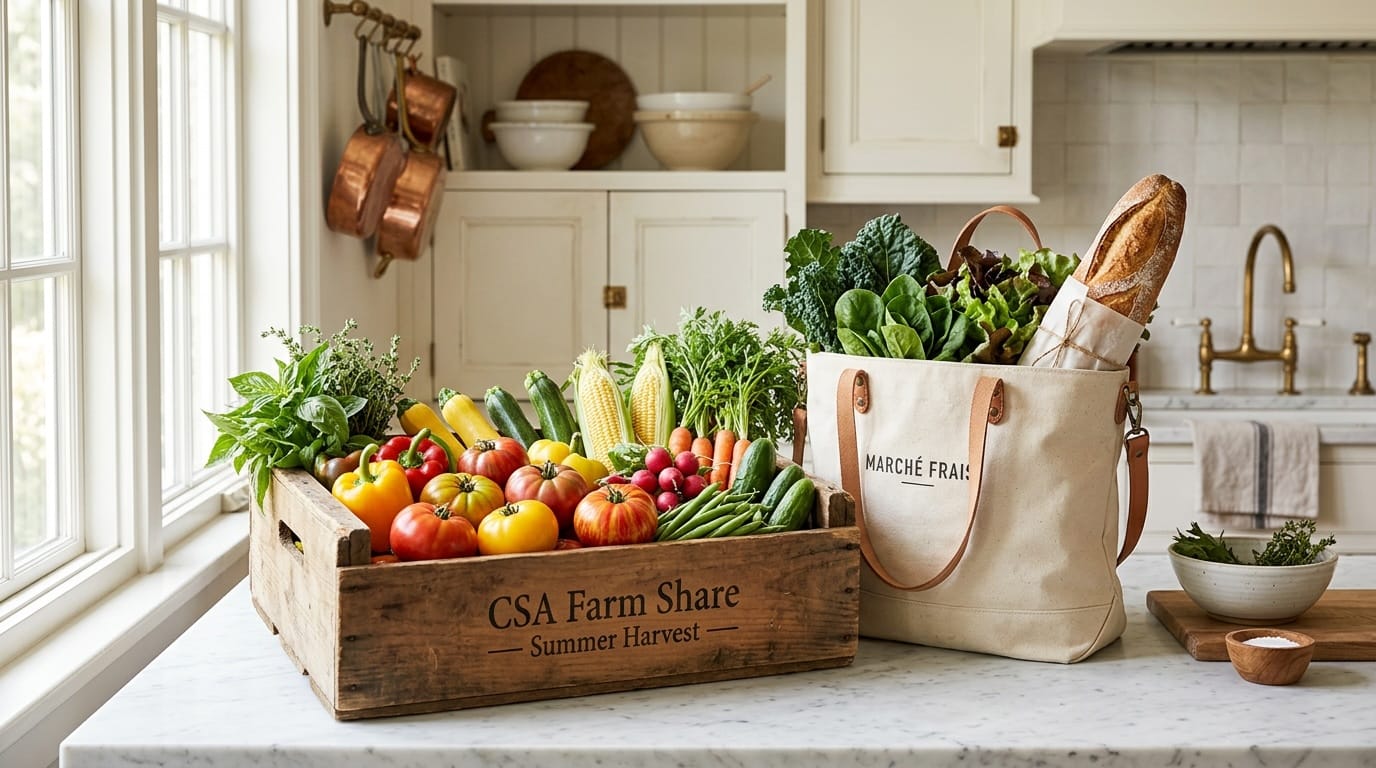
Somebody at work has a CSA share and will not stop talking about it. Somebody else swears by the Saturday market. Both of them seem to be eating better than you are, and you're standing in the grocery store holding a bag of sad clamshell spinach wondering what you're supposed to do about it.
Here's the honest comparison. Neither one is better. They're different tools, and the right answer depends almost entirely on how your household actually cooks — not how you wish it cooked.
What You're Actually Choosing Between
A CSA (Community Supported Agriculture) is a subscription to a farm's harvest. You pay up front, usually before the season starts, and you receive a share of whatever comes in — weekly or biweekly, for 16 to 24 weeks. You're not buying groceries so much as buying into the farm's year, risk and abundance included.
A farmers market is a weekly shopping trip. You pay as you go, you choose every item, and you can buy from a dozen different growers plus the bread person, the egg person, and whoever's making the hot honey this year.
The first is a commitment with a surprise attached. The second is total control with more decisions required. That's really the whole difference, and everything else follows from it.
Cost: The CSA Usually Wins, With an Asterisk
Per pound of vegetables, a CSA share is typically the better deal. Full-season shares commonly run somewhere in the range of $400 to $800 depending on region and size, which usually works out to less per week than buying the same volume item by item.
The asterisk is significant: you only save money on what you actually eat. A share that's a great value on paper becomes an expensive one if a third of it turns to compost because nobody in your house knew what to do with kohlrabi three weeks running.
The market's cost profile is the opposite. You'll likely pay a bit more per pound, but you pay only for things you'll use, you can flex spending down in a tight week, and you never write a $600 check in February. For a lot of households, that predictability is worth more than the per-pound savings.
The Question That Actually Decides It
Forget cost for a second. Ask yourself this: do you cook from a recipe, or do you cook from what's in the fridge?


If you plan meals on Sunday and shop a list, a CSA will fight you every single week. You will open the box, find turnips and a bunch of something leafy you can't identify, and it will not fit the plan. That friction is the number one reason people don't renew.
If you open the fridge, see what's there, and improvise — a CSA is fantastic. It removes decisions, it forces variety, and it will make you a meaningfully better cook within one season. Nothing teaches technique like being handed vegetables you didn't choose.
Be honest about which one you are. Not which one you'd like to be by October.
Where Each One Genuinely Wins
The CSA is better if:
- You want a real relationship with one farm and to know exactly where your food grew
- You cook improvisationally and enjoy a challenge
- Your Saturdays are unreliable and a weekly market trip won't survive soccer season
- You want to support a farm's cash flow directly — CSA money arrives in winter, when farms need it most and have no income
- You want to be pushed out of a rut
The farmers market is better if:
- You have picky eaters or real dietary restrictions and need to choose every item
- You want more than vegetables — eggs, bread, cheese, meat, honey, jam, flowers, prepared food
- You want to buy in bulk when something's at peak, like 20 pounds of tomatoes in September
- Your schedule or budget varies week to week
- You genuinely like the outing — and it is a nice outing
Notice that middle point on the market side. It matters more than people expect. A CSA gives you vegetables. A market gives you dinner. If you want the tomatoes and the sourdough and the eggs from the person who knows the chickens by name, the market is doing something a produce share structurally can't.
The Answer Most People Land On
Do both, at reduced scale.
A half share or biweekly CSA gives you the farm relationship, the variety, and the pleasant push into unfamiliar vegetables — without the volume that overwhelms a two-person household. Then use the market for everything the box doesn't cover: proteins, bread, the specific thing your kid will actually eat, and bulk buying when something hits peak season.
This is what a lot of longtime local-food households quietly settle into after a few years of trying one or the other. It costs a little more than a full share and considerably less than buying everything at retail, and it has the lowest waste of any approach.
Before You Commit to a Share
Ask the farm these five things. Any good farm will answer happily.
- Can I see a sample box list from last season? This tells you more than any brochure. If eight weeks in a row featured something you'd never cook, that's your answer.
- Is there any choice or swap option? Many farms now offer partial customization or a swap table at pickup. It changes the experience completely.
- Where and when is pickup, and what happens if I miss it? A pickup 25 minutes away with a 90-minute window is a commitment you should look at clearly before June.
- Is there a payment plan? Many farms offer one. Fewer advertise it.
- Can I split a share with a friend? Most farms are fine with this, and a split full share is often the best value in local food.
And a low-risk way in: buy from that same farm at the market this season first. You'll see exactly what they grow, taste it, and know whether their vegetables are the ones you want showing up in a box every week next year.
Either way, you're doing the thing that matters — sending your food dollar to somebody who farms nearby instead of a supply chain that stretches across a continent. Find a market near you in our farmers market directory and start there.

Keep reading
More from the market
How to Get Your Baked Goods to Market Without Wrecking Them
Cakes slide, frosting sweats, cookies go soft in the car. The crates, timing and packing order that get your bakes to the…
Read more
How to Store Root Vegetables and Winter Squash So They Last Until Spring
Potatoes, squash, carrots and onions will keep for months if you get a few things right. What each one wants, and the…
Read more
What to Do With Unsold Stock When the Market Season Ends
The last market of the season ends with a car full of what did not sell. Here is how to turn that…
Read more