
One of the most common questions cottage food vendors ask goes something like: “My customer lives three hours away and wants to order my jam. Can I just mail it?”
The answer depends entirely on which state you’re in — and whether you’re shipping within your state or across a state line. Let’s break it down clearly, without the legal-ese.
The big rule that overrides everything: no interstate shipping
Before you get excited about UPS labels, there’s one federal reality to understand: cottage food exemptions are state-level laws. The moment your product crosses a state line, it enters interstate commerce — and federal FDA regulations apply. Your state exemption does not cover that.
That means shipping from Texas to Oklahoma — even though both states have active cottage food laws — is legally off-limits under your cottage food exemption. North Dakota is a rare exception with language that explicitly references out-of-state sales. Nearly everywhere else, you stay within your state lines.
States that allow in-state carrier shipping (24 states)
Based on current cottage food law data, these states explicitly allow in-state shipping via USPS, UPS, FedEx, or other carriers — meaning you can box it up and send it without requiring an in-person transaction:
Alaska, Alabama, Arkansas, Arizona, California, Connecticut, Florida, Georgia, Idaho, Illinois, Indiana, Kansas, Michigan, Minnesota, North Dakota, Nebraska, Nevada, New York, Ohio, Oklahoma, Pennsylvania, South Carolina, Texas, and Vermont.
A few worth flagging specifically:
- Alaska — In-state shipping confirmed under HB 251 (effective August 2024).
- Georgia — In-state shipping expanded under HB 398 (effective July 2025).
- Michigan — In-state shipping now allowed under HB 4122 (effective March 2026).
- Florida & Minnesota — USPS and commercial delivery explicitly permitted by state statute.
States that do NOT allow carrier shipping (8 states)
These states currently prohibit carrier shipping and require either direct in-person sales or vendor-delivered orders: Hawaii, Kentucky, Massachusetts, New Hampshire, Oregon, Tennessee, Virginia, and Washington.
Tennessee is worth noting — the state’s Food Freedom Act is one of the most permissive in the country overall, but delivery must be done by the seller personally. No third-party carriers allowed, even for delivery within the state.
States where the rules aren’t clear (~18 states)
About 18 states have cottage food laws that allow “online sales” or “direct-to-consumer” sales without explicitly clarifying whether carrier shipping is permitted. This group includes Colorado, Iowa, Maine, Maryland, Missouri, Montana, New Jersey, New Mexico, Rhode Island, Wisconsin, Wyoming, and a handful of others.
In these states, the safest move is to contact your state’s Department of Agriculture directly before you ship anything. “Online sales are allowed” doesn’t automatically mean “drop it in a UPS box” — and the interpretation varies.
Your label still matters when you ship
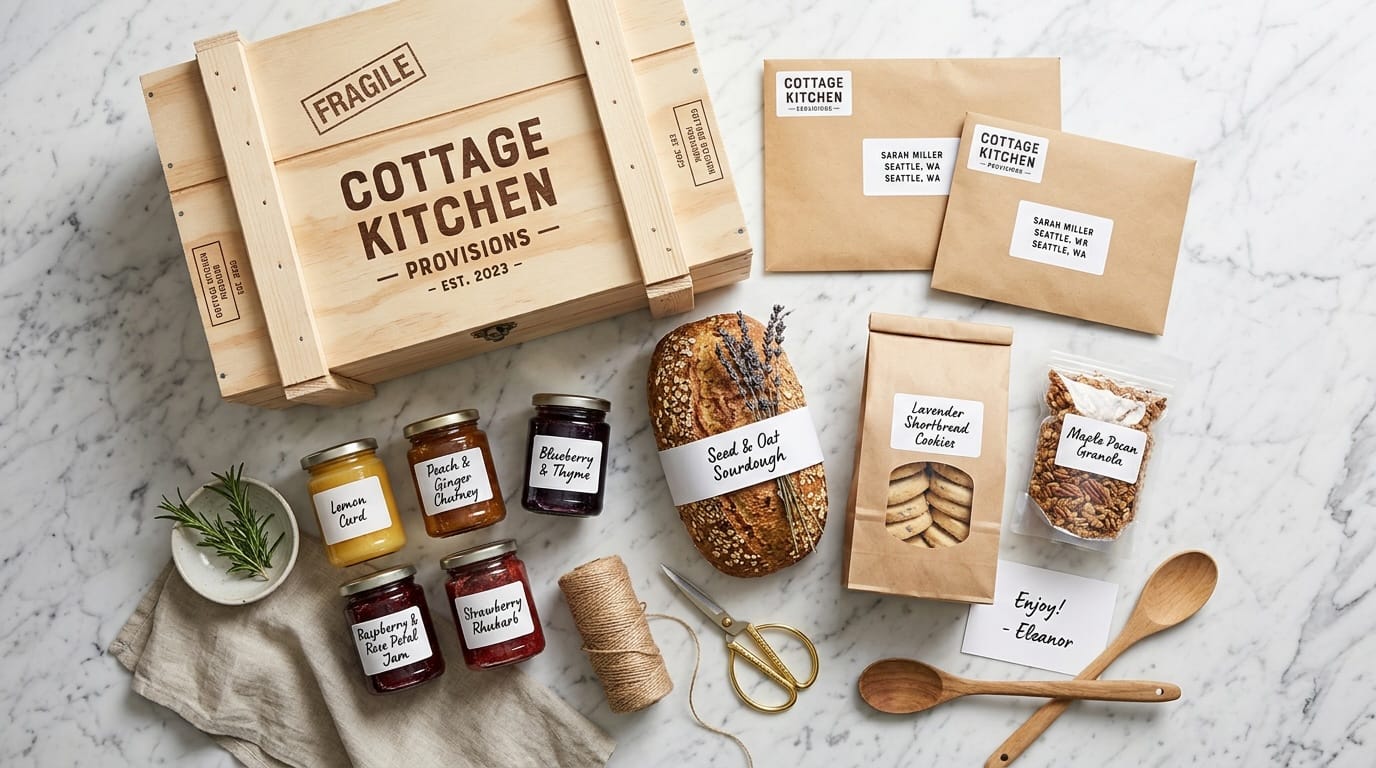
Shipping rules change by state. Label requirements don’t. Your cottage food product must be properly labeled — producer name and address, complete ingredient list, net weight, allergen statement, and the required cottage food disclaimer — before it goes in the box. Some states also require that the label be visible through the outer packaging. When in doubt, label generously.
Want to reach buyers closer to home?
Shipping rules are moving in a good direction — Alaska, Georgia, and Michigan all expanded in the last two years. If your state doesn’t allow carrier delivery yet, the trend is your friend.
In the meantime, connecting with local buyers who can pick up or receive delivery you arrange directly is a powerful way to build your customer base without navigating the shipping question at all. If you’re also looking to sell cottage food online, we’ve got a full guide on that too.
Butter & Sage Market
Reach Buyers in Your Community — No Carrier Required
List your cottage food products on Butter & Sage Market and get discovered by buyers already searching for local food in your area. Direct-to-consumer sales, farmers market connections, and a platform built for cottage food vendors.
Fresh. Local. Sustainable.

0 Comments