
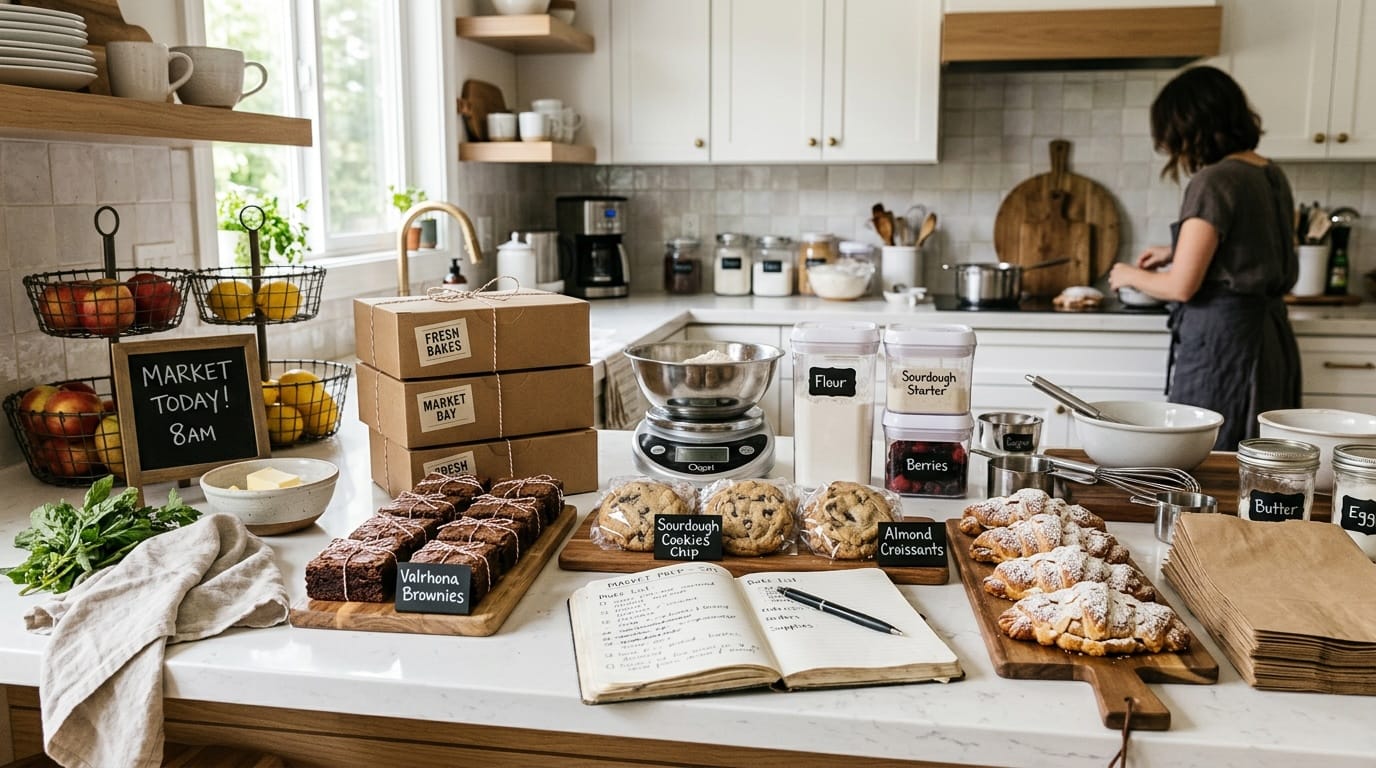

The two-market weekend is a rite of passage. You said yes to the Saturday market you have done all summer, then a Sunday festival came along with a good booth fee and a big crowd, and you thought: how much harder can it be? Twice, roughly. Sometimes three times, if you plan it the way you planned the one-market weekend and simply try harder.
The vendors who do doubles without falling apart are not faster bakers. They front-load. They decide on Monday what Thursday looks like, and by Friday night they are packing, not mixing. Here is the shape of that week.
Monday: decide the number, then never think about it again
Before you touch flour, write down exactly what you are bringing to each market. Not "some cookies." Six dozen chocolate chip, four dozen oatmeal, twelve loaves, twenty jars. Real numbers, per market, per product.
Pull those numbers from your own history, not from optimism. What did you actually sell at this market on this weekend last year, or four weeks ago? For a brand-new event, bring roughly what you would bring to your normal market and no more — a new venue is a test, not a bet. We wrote a whole guide on getting this number right in how much product should I bring to the market.
Then convert the number into a shopping list and buy everything Monday or Tuesday. Nothing wrecks a Thursday like discovering you are two pounds of butter short at nine at night.
Tuesday and Wednesday: do everything that keeps
This is the whole trick, and it is boring, which is why people skip it. Two days out, you do every single task that does not require the product to be fresh.
That means: mix and freeze cookie dough in portioned scoops. Make and refrigerate laminated dough. Cook down fillings, jams, curds, caramels. Toast nuts. Grind spice blends. Make icing bases. Cut parchment. Label every jar and every bag. Build every box. Print the price signs and the shop-link cards. Charge the card reader. Count the cash box and make change.
Labeling deserves special attention, because labeling is the task that always gets pushed to the last hour and it is the one with legal consequences. Do it midweek when you are calm and can actually check that every required element is there — the cottage food labeling requirements guide has the full checklist.
By Wednesday night, the only things left should be things that must be baked fresh.
Thursday and Friday: bake in oven order, not product order
Most burnout in a double weekend comes from baking in the order you think of the products rather than the order the oven can actually do them. Sit down with your list and sort it by temperature and shelf life instead.
Group everything that bakes at the same temperature so the oven never waits on a preheat. Bake the longest-keeping items first — biscotti, granola, brittle, anything shelf-stable — and save the most perishable for last, closest to the market. Cool on racks in a set place. Package in one pass, not as you go, because switching between baking and packaging is where an hour disappears without producing anything.
If you have two markets, split the bake by day where you can. Saturday's most delicate items get baked Friday. Sunday's most delicate items get baked Saturday evening, after you unload — which sounds brutal, and is much less brutal than baking both on Friday and selling day-old product on Sunday.
Set a hard stop time on Friday night. Write it on the whiteboard. When it hits, you stop, even if the last tray is not done, because a vendor who has slept is worth more on market day than four extra dozen cookies.
Pack the truck Friday, in the order you unload it
Load last what comes out first: tent, weights, table, tablecloth, then signs, then risers, then product, then cash box and card reader. Keep a permanent market bin that never gets unpacked — tape, scissors, zip ties, twine, extra price cards, sharpies, wet wipes, trash bags, a phone charger, ibuprofen, and a bottle of water you will forget to drink.
For the second market, do not fully unpack Saturday night. Pull out what needs to be washed or refrigerated, restock the product, and leave the rest in the truck. Unpacking and repacking the same tent twice in twelve hours is a tax you do not have to pay.
Sunday night: write the two numbers down
Before you collapse, write down two things for each market: what sold out, and what came home. That is it. Two lines. Those two lines are the entire input for the next time you plan this weekend, and by Wednesday you will not remember them accurately.
Do that three or four times and you stop guessing. Your Monday number gets sharper, your Thursday bake gets shorter, and the whole weekend gets about thirty percent less frantic without you working any harder.
Butter & Sage Market
Let people order before you bake
Butter & Sage Market gives your cottage food business a shop page and a way for neighbors to order ahead — so your Monday number comes from real orders instead of a guess, and Thursday gets a lot quieter.
Fresh. Local. Sustainable.
The honest part
Some weekends you will still be up too late, and some Sundays you will sell out by eleven and wish you had baked more. That is the job. But there is a real difference between a hard weekend you planned and a hard weekend that happened to you, and the difference is mostly decided on Monday.
What is your non-negotiable prep task — the one you refuse to leave until Friday? Share it. Somebody heading into their first double weekend needs exactly that answer.



0 Comments