The Complete Guide to Cottage Food Labeling Requirements
You've perfected your recipe. You've baked your first batch. You're ready to sell at the farmers market this weekend—and then you realize: "Wait, do I need a label?"
If you're nodding, you're not alone. Labeling is one of those things that sneaks up on new cottage food makers. It's easy to assume that if you're making food in your home kitchen, rules don't apply. But here's the truth: labeling isn't optional, and it's not just about following the law. A great label builds customer trust, answers their questions before they ask them, and makes your product look professional—even if you're starting from your kitchen.
The 7 Things Your Label Must Include
Most states follow federal FDA labeling guidelines, which means you probably need these seven things on every label:
- Product Name — Be specific. "Strawberry Jam" is better than "Jam."
- Net Weight or Volume — In both metric and US measurements. "12 oz (340g)." This has to be accurate.
- Ingredient List — In descending order by weight. If strawberries are 60% of your jam, they go first. Every ingredient counts, including water.
- Allergen Statement — If your product contains any of the Big Eight (milk, eggs, peanuts, tree nuts, fish, shellfish, soy, wheat), clearly label it.
- Name and Address of Your Business — Include your cottage food operation's name and full address.
- State-Specific Disclaimer — Most states require language like: "Made in a home kitchen that has not been inspected by the [State] Department of Health." Check your state's exact wording.
- Production or Best-By Date — Some states require this, others don't. Use a format like "Made on: 03/15/2026" or "Best by: 06/15/2026."
Making Your Labels Look Professional on a Budget
You don't need a designer or a fancy label maker. Three tools work great:
- Canva — Templates are cheap or free. Search "product label," customize, download as PDF, and print on Avery label paper. Total cost: $0–$10.
- Avery Label Templates — Free templates for word processors at avery.com. Print at home, peel, and stick. Cost: ~$15 for a pack of 100 labels.
- Local Print Shop — Once you're scaling, bulk printing is usually cheaper per unit than printing at home.
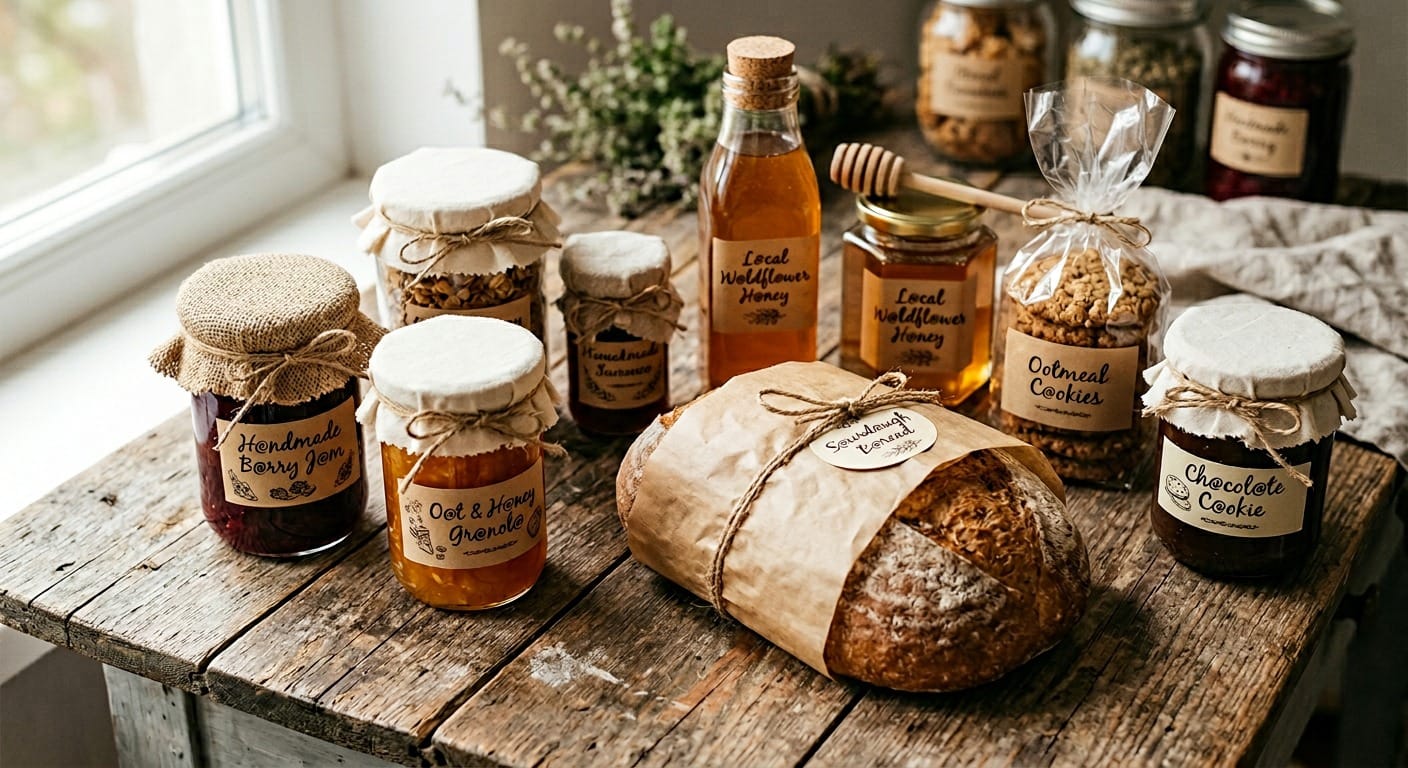
Pro tip: A hand-drawn or rustic design often looks more authentic than trying too hard to look corporate. Customers buying at farmers markets want to support small makers. Your label should feel personal, not manufactured.
Common Labeling Mistakes to Avoid
Forgetting the state disclaimer. This is the #1 reason vendors get stopped at markets. The exact language matters—don't guess. Look it up.
Listing ingredients in the wrong order. Alphabetical order doesn't work here. Go by weight, heaviest first.
Making the allergen statement too small. "Contains tree nuts" in tiny text doesn't count. Make it visible and obvious.
Using a PO Box instead of your full address. Most state laws require the actual address where the food is made. Some states have recently adopted a state registry allowing cottage food businesses to list their registry number to avoid having their home address listed on the label. Check with your state to see if this option is available to you.
Guessing at net weight. "About 12 oz" is not the same as "12 oz." Measure your actual batch every time.
Remember: State Rules Vary
California, New York, Texas, and other states all have slightly different cottage food labeling requirements. Before you design your first label, spend 15 minutes checking your state's cottage food law online—your state's health department website is the best source.
The time you spend now on labeling is the time you don't spend scrambling at your first market. A thoughtful, accurate label signals to customers that you care about the details. That builds loyalty. That gets them coming back.
Label like your reputation depends on it—because it does.
Fresh. Local. Sustainable.

0 Comments