You spent three weeks perfecting the recipe. You costed it out, you tested it on your neighbors, you finally landed on a price that doesn't make you want to lie down. And then you're standing in the packaging aisle at 9 p.m. holding two different clamshells, doing math on your phone, wondering how eleven cents apiece just turned into a real line item.
Packaging is the part nobody warns you about. It's the difference between a product that looks homemade in the good way and one that looks homemade in the "is this safe?" way. And it's usually the first place a new cottage food business quietly loses money.
So let's talk about how to choose packaging for your cottage food products in a way that protects the food, sells the product, and still leaves you a margin worth having.
Start With What the Food Actually Needs
Before you look at a single pretty box, ask what the product physically requires. This is the step that saves you from buying 500 units of something that doesn't work.
Moisture matters most. A crisp cookie in a sealed non-breathable bag goes soft in a day. A soft cookie in a breathable kraft bag goes stale in a day. Same shelf, opposite needs. Crisp items want a barrier that breathes a little or a truly airtight seal with the humidity controlled at packing time. Soft, chewy items want a genuine moisture barrier — a heat-sealed poly bag or a lidded container.
Fat migrates. Anything buttery, oily, or nut-heavy will slowly stain paper packaging. If you're bagging shortbread, granola with a lot of oil, or anything fried, you need a grease-resistant liner or a poly-lined bag. A grease spot on the corner of your label reads as careless even when the product is perfect.
Fragile things need a shape. Decorated cookies, macarons, delicate pastries — these travel badly in bags. A rigid box with an insert costs more per unit but eliminates the "arrived in pieces" refund, which is the most expensive kind of packaging failure.
Jars have their own rules. If you're jarring jams, hot honey, pickles, or shrubs, glass with a two-piece lid is the standard for a reason. It seals, it shows the product, it reads as premium, and customers keep it. Just budget for the weight — glass is heavy and it changes your shipping math entirely if you ever sell online.
The Real Math: What Packaging Should Cost You
Here's the number worth memorizing: packaging should generally land between 5 and 12 percent of your retail price. Under 5 percent, you're often underpackaging and it shows on the table. Over 12 percent, you're subsidizing a box.
Run it on a real product. If you sell a dozen cookies for $18, your packaging budget is roughly $0.90 to $2.16 for everything — box, liner, label, sticker, ribbon, and the little thank-you card you keep meaning to design. That adds up faster than you think. A $1.10 box plus a $0.22 label plus a $0.15 sticker plus $0.30 of ribbon is $1.77, and you haven't bought the liner yet.
Three ways to get that number down without going cheap:
- Buy one size up in quantity, not one grade down in quality. Unit price on packaging drops hard at 250 and again at 500. A slightly nicer box at 500 units often costs less than a mediocre box at 100.
- Standardize your sizes. If every product you make fits into two box sizes and one jar size, you buy deeper on fewer SKUs and you stop storing eleven half-used cases in the garage.
- Let the label do the premium work. A plain kraft box with a beautiful label reads better than a fancy box with a printer-paper sticker. Spend where the eye lands.
Packaging Is Your Booth's Best Salesperson
Here's the thing about a farmers market: your customer decides whether to walk over from about six feet away. They can't smell it yet. They can't taste it yet. All they have is what the package tells them.
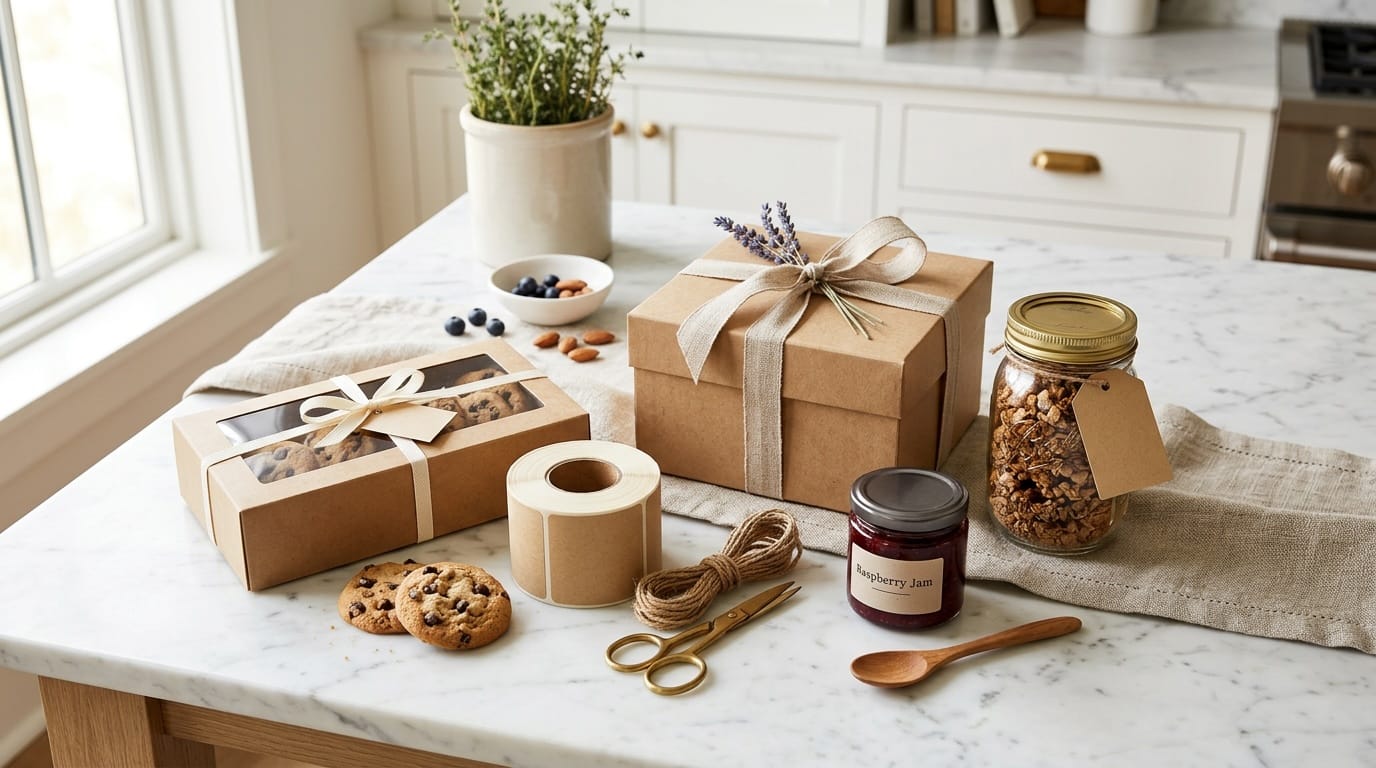
Clear windows sell food. If your product is beautiful — and it is — let people see it. A window box, a clear-front bag, or a glass jar does more selling than any sign you can print. This is the single highest-return packaging decision most vendors make.
Consistency reads as professional. When every product on your table shares a color, a font, and a label shape, shoppers read it as a brand instead of a bake sale. You don't need a designer. You need to pick two colors and one font and then be relentlessly boring about using them.
And leave room for the required label information. Every state has cottage food labeling rules, and nothing is more annoying than falling in love with a tiny elegant box and then discovering your legally required text doesn't fit on it. Check your state's requirements before you order 500 of anything — our complete guide to cottage food labeling requirements walks through what has to appear and where.
Where to Actually Buy It
Most vendors move through three stages, and there's no shame in any of them.
Stage one — restaurant supply and warehouse stores. Cheap, immediate, unbranded. Perfect while you're still figuring out which products stick. Buy plain and add a label.
Stage two — online packaging suppliers. Once you know your sizes, wholesale packaging suppliers cut your unit cost meaningfully at 250 to 1,000 pieces. Order samples first. Always. A box that looks sturdy on a screen can arrive with the structural integrity of a wet napkin.
Stage three — custom printed. Minimums are usually 1,000 or more and lead times run four to eight weeks. Worth it only when you're confident the product isn't changing and the volume is real. Most vendors stay happily at stage two for years, and that's a perfectly good place to live.
One more thing: buy a small heat sealer. They run about $30, they take up less room than a toaster, and they turn a plain poly bag into something that looks like it came off a production line. It's the highest return-on-investment purchase in this entire article.
The Mistakes That Cost the Most
Ordering before testing. Always run a sample through a real market day — heat, humidity, a customer's tote bag, a car ride home. Packaging that works in your kitchen sometimes fails at 94 degrees in a parking lot.
Forgetting the tare weight. If you sell by weight, your container weight has to come out of the math or you're giving product away all season.
Overpackaging small items. A $4 jar in a $1.80 gift box with tissue paper is a lovely gesture and a bad business. Save the gift presentation for a gift-priced SKU.
Buying seasonal packaging in September for a season you haven't sold yet. Holiday packaging is delightful and it does not keep its value. Buy conservatively the first year and reorder if you sell out — running out is a much better problem than a closet full of snowflake boxes in March.
Butter & Sage Market
Your packaging is ready. Is your storefront?
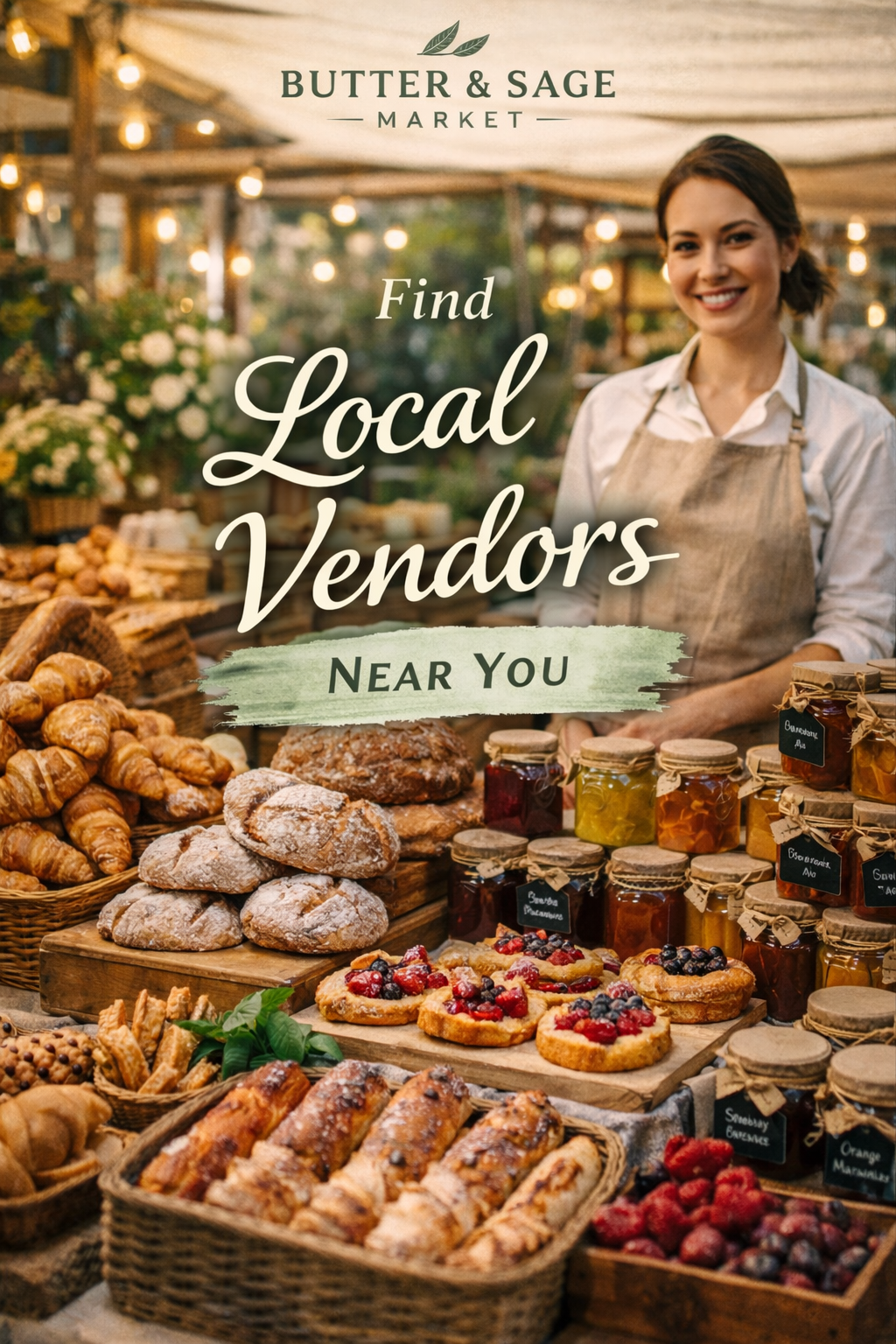
Butter & Sage Market gives small and cottage food businesses a shop page, local discovery, and the tools to sell online — so the products you just packaged beautifully can be found by neighbors who are actually looking for them.
Fresh. Local. Sustainable.
Packaging isn't the fun part. But it's the part that carries your food from your hands to somebody's kitchen table without falling apart, and it's the first impression of everything you've worked for. Get it functional, get it consistent, and get it costed — then go back to the part you actually love.
What's the packaging decision you're stuck on right now? Come tell us in the community. Somebody has already solved it, and they'll be delighted you asked.

0 Comments