
How to Scale a Recipe for Your Cottage Food Business (Without the Math Giving You a Headache)
Doubling flour is easy. Knowing when not to double the salt is the skill. A practical guide to scaling baked goods recipes for your farmers market booth without ruining what made them good.
 1 min read
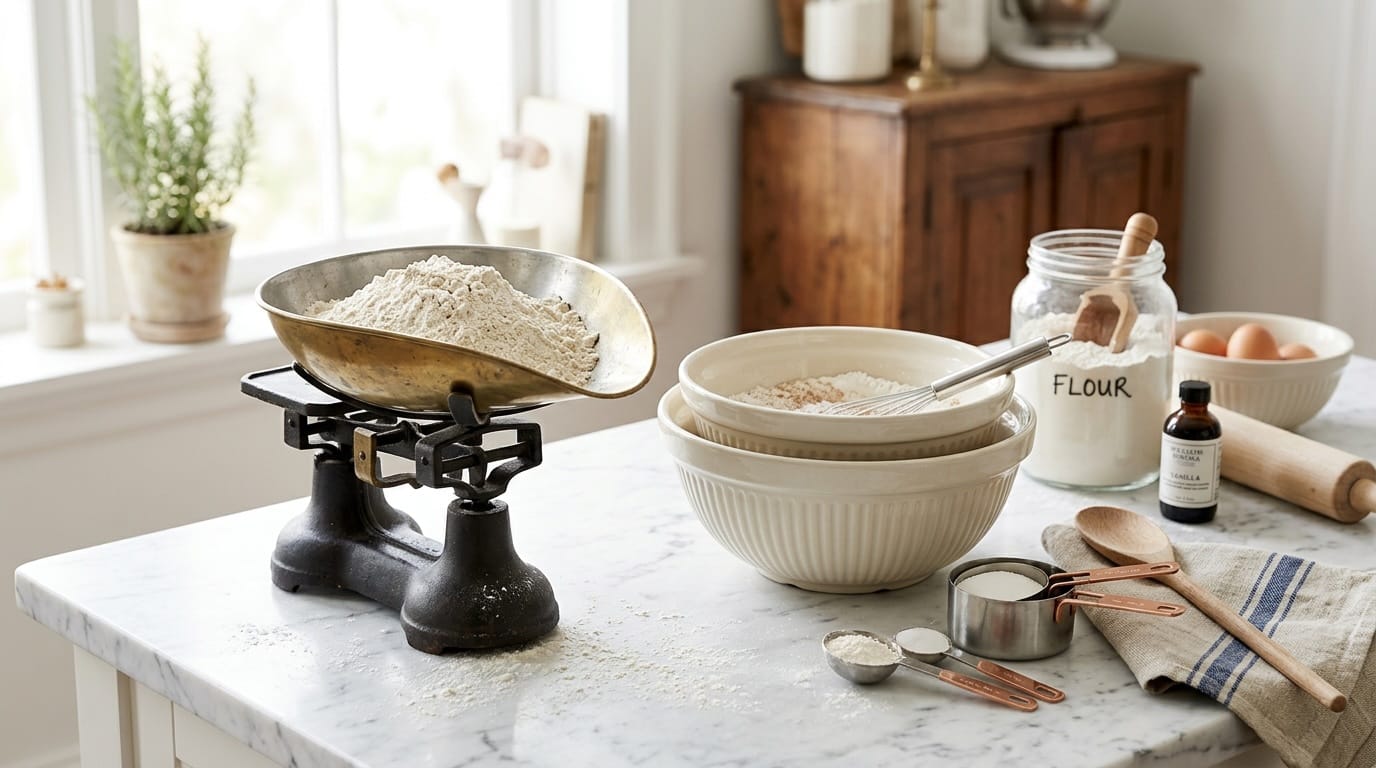
It happens to every cottage food baker the moment their product starts to sell: the batch that used to feed the family suddenly is not enough for the booth. You sold out in the first hour. People asked if you would have more next week. And now you are looking at your recipe — the one that makes two dozen cookies — wondering if you just multiply everything by four and hope for the best.
Sometimes yes. But not always — and the not always parts are exactly where most batch-baking disasters are born. Here is how to scale a recipe for your cottage food business without undoing the results that earned you the customers in the first place.
The Simple Math (And When It Works)
For most ingredients in most baked goods, scaling is multiplication: double the recipe, double every ingredient. Flour, sugar, butter, eggs, milk, fruit, chocolate chips — these scale linearly without issue. If you are going from one loaf of banana bread to four, the math is that straightforward. Write out your scaled amounts before you start, double-check anything that matters, and measure everything before it goes in the bowl. The most common scaling error is not the math — it is the distraction mid-recipe that leads to adding something twice or forgetting a step. A simple habit that helps: write your scaled recipe on paper before you start and cross off each ingredient as you add it. Old-school. Genuinely effective.
The Ingredients That Do Not Scale the Same Way
Salt, leavening agents (baking powder and baking soda), and strong spices are where scaling requires judgment rather than pure multiplication. The conventional wisdom — and a solid starting point — is that these do not need to scale quite as aggressively as the base ingredients. If you are tripling a recipe, start by scaling salt and leavening to 2x rather than 3x, then adjust after your test batch. Too much baking powder creates a metallic or soapy aftertaste and can cause over-rise followed by a sunken center. Too much salt is immediately obvious and completely unrecoverable.
Vanilla extract and other potent flavor extracts follow the same logic. A tablespoon of vanilla in a small batch is lovely. Three tablespoons in a tripled batch can become overwhelming. Scale flavor extracts conservatively and taste the batter before committing to the full scaled amount.


Your Equipment Has Its Own Limits
A standard 5-quart stand mixer bowl can handle roughly a 3-4x batch of most cookie doughs before the machine starts working harder than it should. Beyond that, split the mixing into two runs — which is often faster than you would expect — or invest in a larger mixer if you are scaling into wholesale territory. Oven capacity matters too. More pans mean more baking rounds, and the first pan into a freshly-started oven gets slightly different heat than the fourth pan. For consistent results, rotate pans halfway through baking and note whether later batches run slightly faster due to residual heat. A $15 oven thermometer is one of the most useful tools in a cottage food kitchen.
Always Test Your Scaled Batch Before Market Day
This is the rule that separates experienced cottage food bakers from everyone else: never scale a recipe to a new size and immediately sell the results without testing first. Bake your scaled batch, taste it critically, evaluate texture and appearance, and note any adjustments. Better to discover on a Wednesday that your doubled lemon bars need more zest than to find out at the booth on Saturday with a line of customers waiting.
Keep a notebook with your scaled recipe, the adjustments you made, what worked, and what to change next time. Your tested, scaled recipes are some of the most valuable intellectual property in your cottage food business. The work of figuring it out is a one-time cost that pays off on every production run after.
Give Yourself More Time Than You Think You Need
A batch of four dozen cookies takes longer than a batch of one dozen in ways that are not just linear. More dough to portion, more pans to manage, more cooling racks, more cleanup. When scaling significantly, block out at least 30-50% more time than your standard batch takes. And if you are working against a pre-order deadline, pad that estimate generously — large production runs have a way of expanding to fill all available time and then a little more. The good news: once you have scaled a recipe and worked out the kinks, every production run after is dramatically faster. The hard work of figuring it out is a one-time cost with a very long payoff horizon.


Keep reading
More from the market

How to Make Stock from Your Market Scraps (The Free Ingredient in Your Freezer)
A bag in the freezer, filled with onion ends and carrot tops, becomes the best ingredient in your kitchen for free. What…
Read more
How to Roast Any Vegetable (One Method, Your Whole Market Haul)
One temperature, one pan, three rules that decide everything. Timings for the whole fall market table, and the crowding mistake that steams…
Read more
How to Grill Summer Vegetables (Eggplant, Zucchini, Peppers & More)
Grilling turns a farmers market vegetable haul into the best part of dinner. Here's how to grill eggplant, zucchini, peppers, and onions…
Read more