
How to Set Farmers Market Vendor Fees That Keep the Market Running
How to set farmers market vendor fees: build the budget, find your break-even per stall, choose flat, percentage or season fees, and explain every dollar.
 5 min read
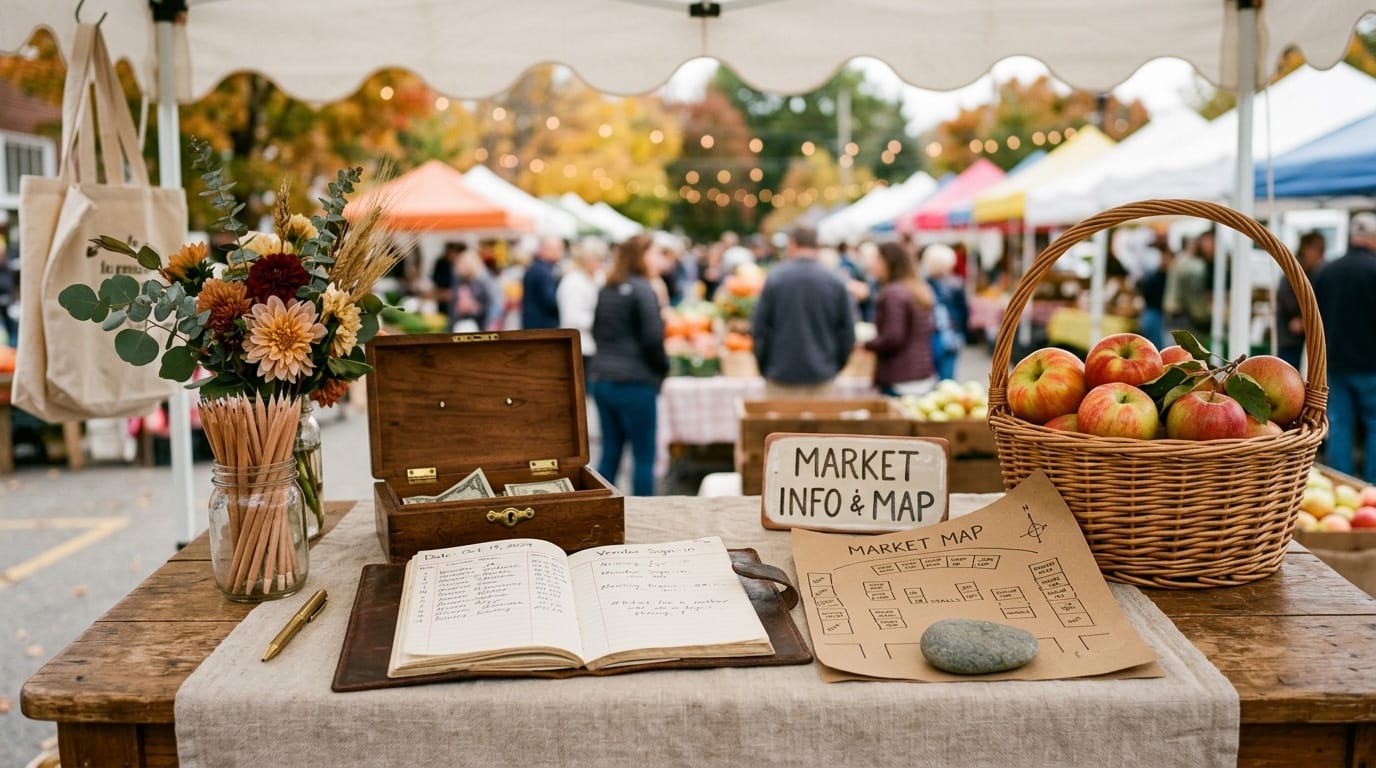
Vendor fees are the first number every vendor looks at and, too often, the number a new market copies from the town next door. That is backwards. Knowing how to set farmers market vendor fees starts with what your market costs to run, then picks a structure that feels fair to a large farm and a first-year baker alike.
There is no formula handed down from on high. The Farmers Market Coalition says so plainly in its market policies guidance: “There is no universal method for determining how a market will charge fees for their vendors.” What there is, is a method.
What your fees have to pay for
The USDA Agricultural Marketing Service guide How to Start a Farmers Market calls vendor fees “a primary source of income for farmers markets,” and lists what they typically fund: the manager’s pay, advertising and site upkeep. A realistic annual budget usually includes more.
- Liability insurance for the market
- Permits and any site rent
- Promotion: signs, banners, printing, ads, a website
- Supplies: cones, an info tent, tables, sandwich boards
- Card and EBT processing costs, if the market runs a token program
- A manager, paid or a volunteer stipend, now or soon
- A small reserve for a rained-out month
Write every line down with a real number from a quote or last year’s receipts. Then subtract whatever comes from sponsors, grants or the town. What is left is the amount vendors need to cover.
How to set farmers market vendor fees from the budget up
Here is the math, using made-up round numbers just to show the method. Say the season budget is $9,000 and a local sponsor covers $2,000, leaving $7,000. You expect 14 vendors across a 24-week season, and from experience about 85 percent of them attend on a given week. That is roughly 285 stall-days. Divide $7,000 by 285 and you get about $24.50 per stall per market day just to break even.
That break-even figure is your floor, not your fee. You can then decide how to collect it: a flat daily rate near that number, a season fee that works out a little lower, a percentage of sales that should average out to it, or some mix. Do the math for each option before choosing one.
The Massachusetts Department of Agricultural Resources’ guide to running a farmers market makes the point that matters most to vendors. A farmer who grosses $1,000 at a well-run market paying $10 a day is far better off than one paying $1 a day at a poorly run market that grosses $100. Vendors will pay a fair fee for a market that brings shoppers.



Flat, percentage or both
Most markets use one of a few structures, often in combination: an annual membership or base fee, a flat fee per market day, a fee for the whole season, or a percentage of each vendor’s sales. The Coalition notes that a percentage fee “does not disproportionately burden smaller-scale or beginning producers,” since a vendor who sells less pays less. The tradeoff is that it depends on honest reporting, and the Coalition suggests random audits to keep everyone honest.
Real fee schedules show how varied this gets. An Oklahoma State University Extension fact sheet listed several Oklahoma markets’ published fees as of April 2022. One charged $5 a day or $25 for the season. Another charged a $15 annual membership plus 10 percent of gross sales, capped at $10 a day. A third charged a $35 membership plus 5 percent of weekly sales, capped at $30. Portland Farmers Market’s 2026 stall fee chart mixes both models: flat fees that vary by stall size and season for farmers, and percentages of gross sales for bakery and hot-food vendors, with the note that the vendor “pays the appropriate percentage fee or the Food Artisan rate, whichever is greater.”
Those are examples of how markets structure fees, not benchmarks. A city market drawing thousands of shoppers and a Tuesday market on a church lawn should not charge alike.

Fees are easier to collect when the records keep themselves
Farmers Market Manager is coming for the people who organize markets. Founding markets get it first.
Join the founding markets
Fresh. Local. Sustainable.
Stall fees, season fees and fees that shape your mix
Season fees bring in cash before opening day, when insurance and printing bills arrive, and they commit vendors to showing up every week. Daily fees welcome newcomers and seasonal growers who only have product for six weeks. Many markets offer both, pricing the season fee as a modest discount on the daily rate.
Fees also shape who applies, so use them on purpose. Corner and double-depth stalls can cost more, as they do on Portland’s chart. The University of Nevada, Reno Extension fact sheet Attracting Vendors and Customers to Rural Farmers Markets describes a market offering reduced fees to local mom-and-pop vendors. A lower rate for first-year farmers, or a fee cap during the thin weeks of early spring, can fill exactly the gaps you need filled.
Be open about where the money goes
Vendors rarely object to a fee they understand. They object to one that appears without explanation or changes mid-season. Publish the fee schedule with the application, explain what the fees fund, and share a one-page summary of the market’s budget at the end of each season. If fees have to rise, give notice before applications open, with the reason in plain numbers.
Write down the awkward cases in advance, too: whether fees are refunded when weather cancels a market, what happens when a vendor leaves halfway through the season, and when payment is due. Then apply those rules the same way for everyone.
A fair fee is one a vendor can predict, understand and see at work every Saturday.Butter & Sage Market
It also helps to remember what fees mean on the other side of the table. Vendors fold your fee into their own prices, which is exactly what our pricing formula for market vendors teaches. If your market runs SNAP/EBT tokens, our guide to accepting SNAP/EBT at a market booth shows the vendor’s side of that system as well.
How does your market charge now: flat, percentage or a mix? Tell us in the comments what has worked and what caused grumbling.

Keep reading
More from the market
How to Order Holiday Pies from a Local Baker (Before the List Closes)
Local pie lists close early. When to order holiday pies from a neighborhood baker, what to ask before you pay, and how…
Read more
How Much to Charge for a Dozen Cookies (The Math Behind the $12 Myth)
How much to charge for a dozen cookies? We cost a real four-dozen batch line by line and show what the familiar…
Read more
How to Build a Thanksgiving Table from the Farmers Market
Most of Thanksgiving grows within an hour of your house. Here is what to buy at the market, what to reserve now,…
Read more