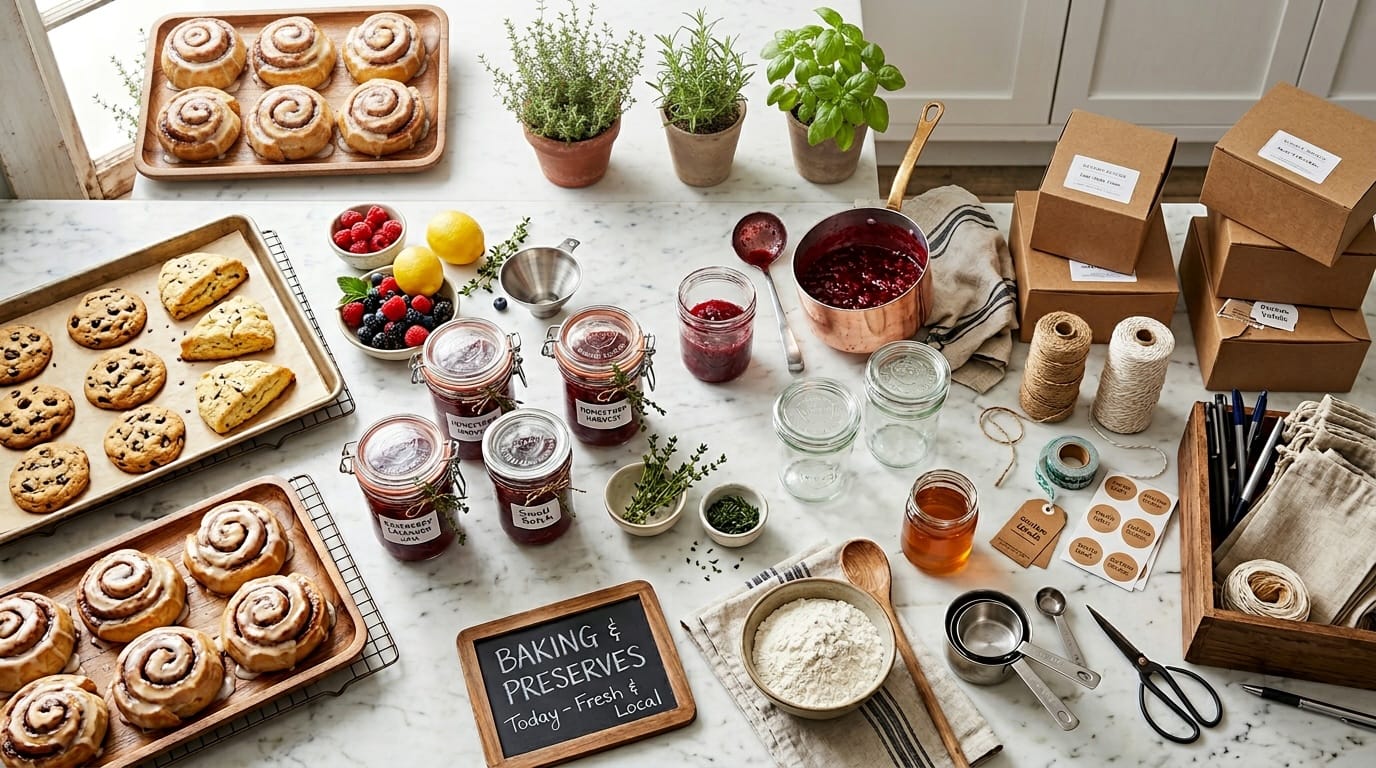

It starts innocently enough. Your sister offers to help you bag granola on a busy weekend. Your neighbor volunteers to do labels. Your kid suggests they could frost cookies for a cut of the profits. And suddenly you're googling "cottage food employee rules" at 11pm wondering if you've accidentally become an employer.
Here's what you need to know — before anyone pulls on an apron.
The general rule: household members are usually fine
For the vast majority of states, cottage food laws assume you're operating as an individual or with help from people who live in your household — spouse, kids, parents, anyone who shares your address. These helpers are typically permitted without additional requirements.
The law treats household assistance differently from paid employment because it doesn't trigger labor law requirements, workers' compensation obligations, or the commercial kitchen implications that come with hiring outside staff.
What this looks like in practice: your spouse bags cookies while you frost them. Your teenager helps set up your farmers market booth. Your mom stirs jam on a busy Saturday. These are generally covered under the household assistance concept in most state cottage food laws — even in states that don't spell it out explicitly.
States with specific employee rules
California — one non-household employee allowed. This is unique in the country. Class A and Class B CFO operators can hire one full-time equivalent non-household employee in addition to household members. No other state's cottage food law explicitly permits hiring an outside person. The employee must work within your registered CFO operation.
Illinois and Massachusetts — household members only. The exemption extends only to the operator and people who live in the same home. Outside helpers, even unpaid, aren't covered.
South Dakota — household members only. Same framework.
Kentucky, Louisiana, and Minnesota — very limited assistance. Restrictive language that essentially limits production to the operator and closely defined household members. Read your statute carefully before involving anyone else.
Food freedom states (Wyoming, Utah, North Dakota, Alaska, and others) — generally more flexible. While employee restrictions aren't always spelled out explicitly in food freedom frameworks, the overall structure tends to be more permissive. Check your specific state's language.
Paid vs. unpaid — does it matter?
It might. In states that restrict production to the operator or household members, bringing in an unpaid volunteer is still potentially a problem — it's not about the money, it's about who is legally part of the production process. If your state says "household members only," having your neighbor help package products regularly — even for free — may not be covered.
What happens when you outgrow your household?
This is the right question, and it means your business is working. Most cottage food laws were designed for one-person or one-household operations. When you outgrow your household's production capacity, you've likely outgrown the cottage food framework — and that's not a failure. That's success.
At that point: rent commissary or commercial kitchen space (opens the door to real staff); partner with a co-packer that can produce your recipe at volume; or apply for a commercial food production license in your state.
Before you do anything — check your actual state law
State cottage food statutes are inconsistent in how they define "household" and "employee." Some use "family member." Some say "household member." Some don't define either. Before you bring anyone into your kitchen for production — paid, unpaid, or otherwise — read your state's specific cottage food statute, not a summary of it. Your state's Department of Agriculture website is the right starting point.
Butter & Sage Market
Build Your Cottage Food Business on a Platform That Gets It
Whether you're a solo operation or building something bigger, Butter & Sage Market is designed for small and cottage food businesses at every stage. List your products, get found by local buyers, and grow on your own terms.
Fresh. Local. Sustainable.

0 Comments